

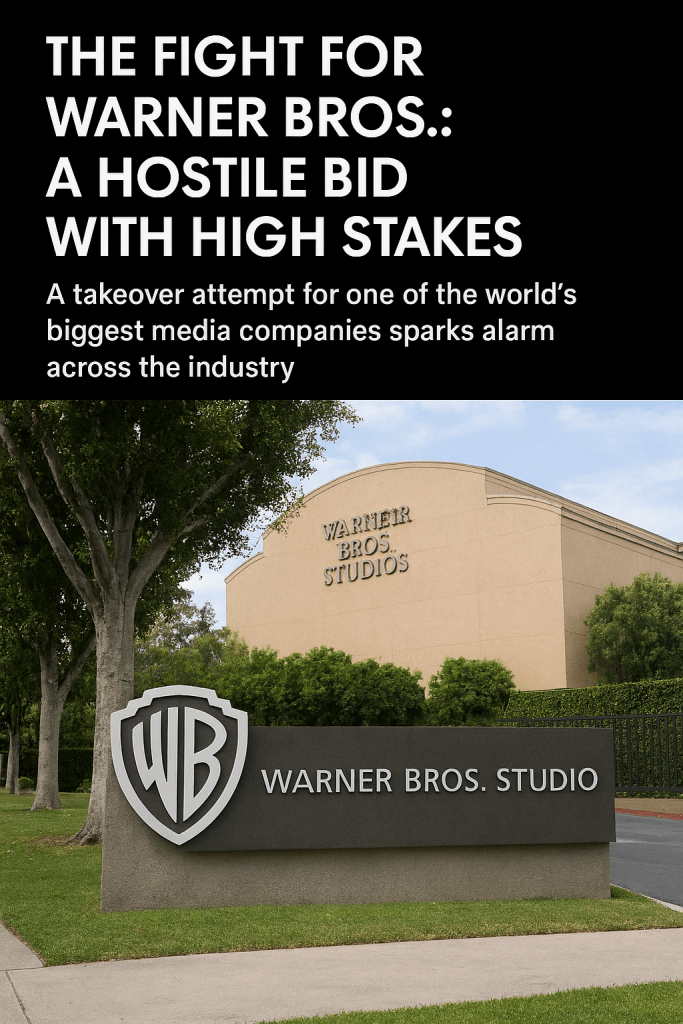
The Fight for Warner Bros.: A Hostile Bid With High Stakes
David Ellison’s hostile takeover bid for Warner Bros. Discovery has sparked growing alarm across the entertainment industry, political watchdog groups, and media‑freedom advocates, who warn that the attempt carries not just corporate implications but profound risks for the independence of one of the world’s most influential cultural institutions. Yet even in this moment of uncertainty, something powerful is emerging: a renewed awareness of how deeply people depend on free expression, honest journalism, and the creative voices that help us understand ourselves and one another. This isn’t just a business fight — it’s a defining moment for the future of storytelling and the values that sustain a democratic culture.
Ellison, through Paramount Skydance, launched the hostile bid after the Warner Bros. Discovery board favored a competing offer from Netflix. Multiple reports confirm that Ellison’s team has emphasized its “friendly relationship with the Trump administration” as a potential advantage in securing regulatory approval. This signal has intensified concerns about political entanglement at the highest levels of the media landscape. For many, the fact that political access is being used as a selling point is not just unusual; it is a stark reminder of how vulnerable media independence becomes when power and influence converge.
That concern is amplified by Ellison’s personal proximity to President Trump. Ellison and his father, Oracle founder Larry Ellison, are longtime Trump allies, and the president has publicly praised David Ellison as a “great man” who will “do the right thing” with CBS and Paramount. Ellison has reportedly met with Trump at the White House to discuss the Warner Bros. bid, and his leadership team has positioned their political ties as a strategic asset in the merger process. To many in the industry, this is not simply a red flag — it is a call to vigilance.
As Paramount aggressively frames its bid as better for Hollywood, creators, and theaters, the industry’s reaction has been far more cautious — and in many corners, deeply emotional. Writers, directors, and showrunners fear that a hostile takeover signals cost‑cutting, consolidation, and diminished creative autonomy. These are people who devote years of their lives to stories that help audiences feel seen and understood. The idea that political pressure could seep into that process feels, to many, like a direct threat to the cultural heartbeat they work so hard to protect. And yet, their concern is also a testament to how fiercely they believe in the power of their craft.
Theaters, while intrigued by Paramount’s pro‑theatrical messaging, remain unconvinced. Exhibitors appreciate the promise of a stronger theatrical slate, but they also understand the fragility of their own recovery. They’ve lived through closures, layoffs, and uncertainty. They know that promises made during a takeover often evaporate once restructuring begins — and a hostile takeover is almost always followed by aggressive cuts. Still, their cautious hope reflects a belief that cinema can endure, even in turbulent times.
Studio executives and insiders see the move as risky and destabilizing. Many have spent decades navigating an industry that is constantly shifting beneath their feet. To them, this bid feels less like a vision for the future and more like a gamble — one that could upend Hollywood’s ecosystem and concentrate power in ways that are difficult to reverse. But their willingness to speak out shows a commitment to protecting the institutions that have shaped generations of artists and audiences.
Journalists and media‑freedom advocates are the most alarmed. They know firsthand how essential independent reporting is to a functioning democracy. They’ve watched colleagues face harassment, layoffs, and political pressure. For them, the idea of a major news‑producing studio being led by a team openly touting political ties is not an abstract concern — it is a direct threat to the safety, integrity, and independence of their work. Their alarm is not fear; it is a form of courage — a refusal to let silence or complacency erode the foundations of a free press.
Investors, meanwhile, are split. Some are drawn to the higher cash offer, while others worry about regulatory hurdles, financing stability, and the optics of a politically aligned takeover. Even in the financial world, where numbers often dominate the conversation, there is a growing recognition that this decision carries consequences far beyond shareholder value. Their deliberation reflects a broader truth: markets don’t just measure profit — they measure trust.
Analysts say the danger extends far beyond corporate restructuring. Warner Bros. Discovery is a central pillar of global entertainment and journalism, producing content that reaches hundreds of millions of people. A takeover by a leadership group with close political ties to the administration raises fears of potential pressure on news operations, editorial decision‑making, and the broader cultural output of the company. The risk is not just that the content could change, but that the public’s faith in its integrity could erode.
These concerns are amplified by Donald Trump’s well‑documented pattern of publicly attacking media outlets that scrutinize him and praising those that offer favorable coverage. His history includes calls for firings, demands for punitive action against journalists, and efforts to influence network decisions. Experts warn that placing a major studio under the leadership of a president who has repeatedly sought to shape media coverage poses a direct threat to newsroom independence and the creative freedom of content producers.
But observers also note something else: moments like this reveal how deeply people value independent media in their lives. Warner Bros. Discovery is not just a corporation — it is a cultural anchor. It produces the journalism people rely on during crises, the stories that help families feel connected, and the narratives that inspire new generations to imagine a better world. Protecting that independence is not only a business decision; it is an act of stewardship — and the stakes have rarely been higher. The intensity of the public response shows how much people believe in the power of free expression.
Industry analysts say the explicit invocation of political relationships in a takeover bid is highly unusual and could signal a shift in how media consolidation intersects with political power. The prospect of a major entertainment company becoming more closely tied to partisan interests has raised questions about the long‑term implications for public trust, cultural autonomy, and the safety of journalists who rely on institutional protection.
Shareholders now face a decision that carries significant consequences. Beyond financial considerations, the outcome could determine whether Warner Bros. Discovery remains an independent cultural force or becomes vulnerable to political influence at a moment when the role of media in a democratic society is already under intense pressure. Many advocates argue that this is a moment to reaffirm the principles that have long guided the industry: transparency, independence, and a commitment to serving the public good.
The tender offer remains active as shareholders evaluate both the financial terms and the broader risks associated with a potential change in ownership. Whatever the outcome, the debate surrounding the bid has underscored a powerful truth: the future of media is not predetermined. It is shaped by the choices people make — choices that can either protect the integrity of cultural institutions or allow them to drift into the orbit of political power. And in this moment, the danger of drifting has never felt more real — nor has the opportunity to stand up for the values that make storytelling, journalism, and creative freedom possible.
References :
- Business Insider — reporting that Paramount Skydance launched a hostile bid
👉 https://www.bing.com/search?q=Business+Insider+Paramount+Skydance+hostile+bid+Warner+Bros+Discovery - Variety — confirmation of the all‑cash tender offer
👉 https://www.bing.com/search?q=Variety+Ellison+all+cash+tender+offer+Warner+Bros+Discovery - Yahoo Finance — coverage of the $30 per‑share hostile bid
👉 https://www.bing.com/search?q=Yahoo+Finance+Paramount+hostile+bid+Warner+Bros+Discovery - Fightful — reporting on the $108 billion takeover attempt
👉 https://www.bing.com/search?q=Fightful+108+billion+hostile+takeover+Warner+Bros+Discovery - The Hollywood Reporter — detailed coverage of the hostile offer
👉 https://www.bing.com/search?q=Hollywood+Reporter+Paramount+hostile+offer+Warner+Bros+Discovery - CNBC — confirmation of the bid and the “friendly relationship” with the Trump administration
👉 https://www.bing.com/search?q=CNBC+Paramount+Skydance+hostile+bid+friendly+relationship+Trump+administration

Peppermint Village
This holiday classic comes to life with the smell of fresh mint, cornmint, and peppermint, along with base notes of camphor and mint flower.
C10170………………..Price $17.54
 Mentonym Express