


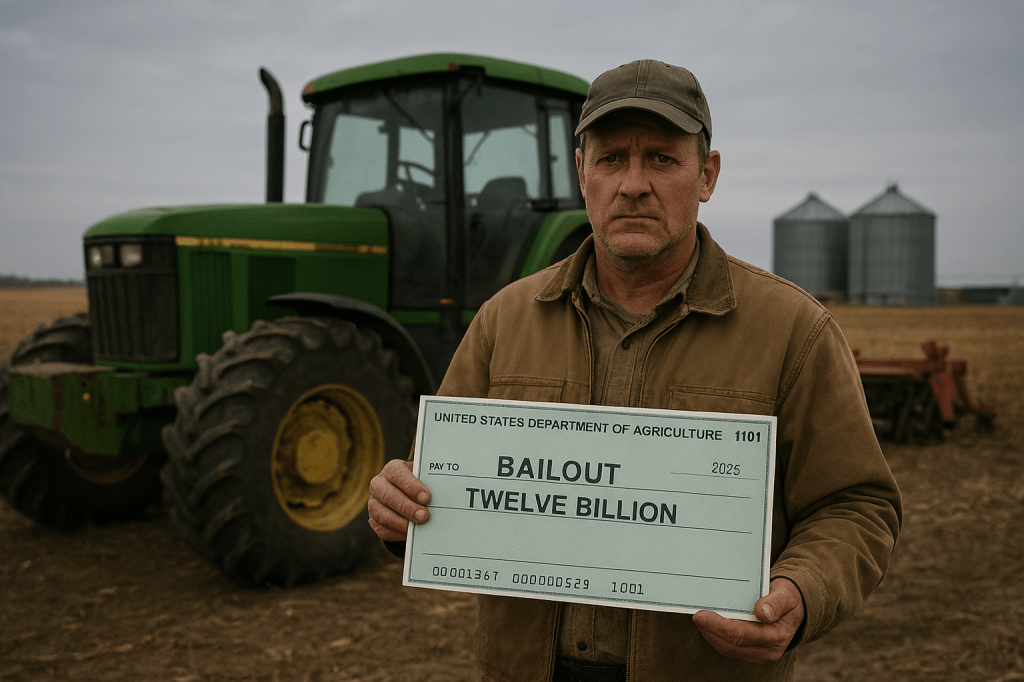

When Donald Trump imposed sweeping tariffs on America’s trading partners, his administration branded them a “lifeline for the middle class.” Supporters claimed tariffs would protect U.S. jobs and industries. But years later, the reality is undeniable: higher consumer prices, disrupted supply chains, lost export markets, and taxpayer-funded bailouts.
The latest example came in December 2025, when Trump announced a new $12 billion bailout for farmers. The aid, scheduled to begin distribution in February 2026, is intended to offset losses from retaliatory tariffs that slashed demand for U.S. crops such as soybeans, corn, wheat, and pork. This bailout was not triggered by a natural disaster or market collapse — it was the direct consequence of Trump’s own tariff policies. Without those tariffs, there would have been no need for a bailout.
Before Trump’s trade war, American farmers operated in a relatively stable environment. Agreements like NAFTA and the WTO provided reliable export markets, while government programs such as the Farm Bill offered crop insurance and conservation funding. These supports gave farmers a measure of security against unpredictable weather and volatile markets. Farmers exported billions in soybeans, corn, and wheat to China, Canada, and Mexico, sustaining rural economies and providing continuity across generations.
That stability collapsed when Trump’s tariffs took effect. Retaliatory duties from China and other partners cut off demand for U.S. crops, allowing competitors like Brazil to capture market share. Equipment costs soared as tariffs on steel and aluminum drove up prices by nearly 80 percent. Cuts to USDA programs further strained farmers, leaving food banks and local nutrition initiatives underfunded. For families who had long relied on these programs, the disruption was not abstract — it meant bare shelves, unpaid bills, and agonizing choices about whether to keep farming at all.
The 2025 bailout is not the first. During Trump’s first term, his administration approved $28 billion in farm aid between 2018 and 2019 through the Market Facilitation Program. That package was billed as relief for farmers hurt by retaliatory tariffs, but it disproportionately benefited large agribusinesses while leaving small family farms struggling. Now, history is repeating itself. The new $12 billion package is another emergency measure forced by Trump’s tariffs. Analysts warn that bailouts are temporary fixes, not solutions. They cannot restore lost export markets, rebuild broken supply chains, or reverse years of stalled investment. Farmers themselves have voiced frustration, saying checks may help pay bills but cannot rebuild markets or erase years of losses. For many, the aid feels less like a lifeline than a stopgap — a way to survive the season, but not a path to stability.
Trump’s tariffs didn’t just hit agriculture. They rippled through supply chains, raising costs for manufacturers and retailers. Automotive suppliers idled production lines. Appliance prices rose. Families paid hundreds to thousands of dollars more per year due to inflated consumer costs. Rural communities bore the brunt. As farm incomes collapsed, local businesses, schools, and governments lost revenue. Population declines accelerated as families sold land or left farming altogether. The stress fueled a mental health crisis among farmers, with rising rates of depression and anxiety. Behind every statistic is a family weighing whether to continue a tradition passed down for generations or walk away from land that has defined their identity.
The impact is visible in individual lives. Rachael Bouressa, a fifth-generation Wisconsin farmer, struggled to meet obligations after USDA contracts froze. Adam Chappell, an Arkansas farmer managing 800 acres, faced uncertainty as conservation programs were cut. In West Virginia, Jennifer Gilkerson saw demand for her freeze-dried fruits collapse, leaving her unable to support schools and food banks as she once had. Marty Marr in Illinois battled rising equipment costs and shrinking markets, watching his margins disappear. These stories are not isolated — they echo across the country, each one a reminder that behind policy debates are human beings carrying the weight of decisions made far from their fields.
The economic damage has political consequences. Broad Republican support for Trump’s tariff program tied the party to policies that produced measurable harm: higher consumer prices, lost export markets, regional recessions, and taxpayer-funded bailouts. In swing districts, voters living with the fallout daily have grown skeptical of promises that tariffs protect American workers. For families who feel forgotten, the political rhetoric rings hollow.
As the $12 billion bailout rolls out in 2026, the central question remains: will policymakers continue to patch over crises of their own making, or will they pursue trade policies rooted in reality — predictable rules, targeted support, and strategies to restore market access? For farmers and families across America, the answer may determine whether resilience is rebuilt — or whether volatility becomes the new normal.
Because bailouts, however large, are not a substitute for sound policy. They are temporary relief measures that mask deeper structural failures. Checks can help farmers pay bills or keep operations afloat for a season, but they cannot restore lost export markets, rebuild broken supply chains, or reverse years of stalled investment. They cannot undo the damage caused by competitors like Brazil permanently capturing soybean contracts, or by rural banks tightening credit as farm bankruptcies rise.
The stakes extend beyond agriculture. Trump’s tariffs function like a regressive tax, raising prices for households while shrinking real incomes. They suppress demand, discourage investment, and risk pushing the economy toward stagflation — high inflation paired with rising unemployment. If policymakers continue to rely on bailouts instead of reform, the U.S. risks entrenching a cycle of crisis management: tariffs trigger retaliation, retaliation forces bailouts, bailouts strain taxpayers, and taxpayers lose faith in government promises.
Politically, this cycle erodes credibility. Voters in hard-hit districts see the disconnect between rhetoric and reality. They live the consequences every day — higher grocery bills, shuttered plants, shrinking farm incomes — and they know that one-time checks do not equal long-term stability. The promise of tariffs as protection has become a liability, weakening trust in leaders who continue to defend them.
But there is another path forward. A trade policy rooted in reality can rebuild trust, restore markets, and empower families. Predictable rules can give businesses confidence to invest. Targeted support can address genuine market failures without distorting entire industries. Investment in supply-chain modernization can reduce fragility and bottlenecks. Restoring market access for exporters can rebuild relationships abroad and secure long-term demand at home.
Resilience isn’t inherited — it’s built. And it is within reach. America’s farmers have always been symbols of endurance, working through droughts, floods, and storms. Communities have always found ways to adapt, to innovate, and to rise again. The $12 billion bailout is a reminder of what happens when trade policy is driven by short-term politics instead of long-term vision. But it can also be a turning point — a chance to demand better, to insist on policies that strengthen households, empower farmers, and stabilize communities.
The question for 2026 is whether America will continue down the path of crisis and bailout — or whether it will finally choose a course that rebuilds resilience, restores credibility, and secures prosperity for the middle class and the farmers who feed it. The choice is ours, and the future can be brighter if we build it together.
References:
Tax Foundation – Tariffs and Trade War Effects on U.S. Households
Brookings Institution – Did Trump’s Tariffs Benefit American Workers?
Newsweek – The Surprising Impact of Trump’s Tariffs on American Farmers
Politico – Trump Plans Bailouts Using Tariff Revenue
USA Today – Iowa Farmers Reject Bailout Politics
CBS News / 60 Minutes – Farmers Fear Losing Family Farms
Civil Eats – Farmers Struggle With Tariffs Despite China Deal
AgDaily – Tariffs and Trade: What Farmers Lost
Reuters / IndustryWeek – Tariffs Force U.S. Firms to Cut Jobs and Delay Investment
GZERO Media – Farmers Feel the Impact of Trump’s Trade Policies
Tri States Public Radio – Trump Administration Will Send $12 Billion in Bailout Money to Farmers Hurt by Trade War
[Reason – Trump’s $11 Billion Farm Bail

Anime Cat
Embark on an enchanting journey with an anime cat as it explores a vibrant forest adorned with pink flowers and lush greenery on this 7.5-inch mousepad. Experience the magic today! CMP10011…….$7.50
 Mentonym Express