


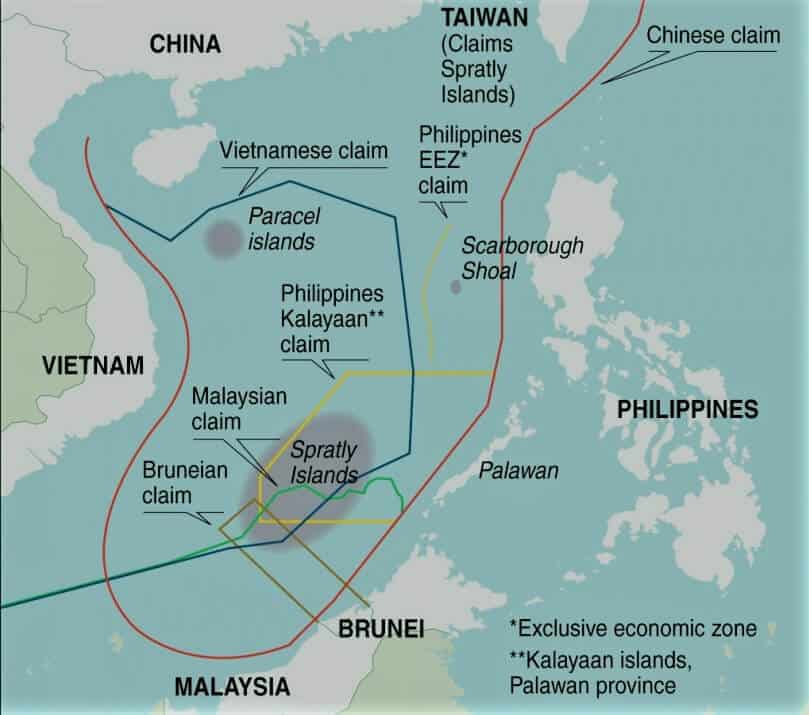
The South China Sea holds immense geopolitical and economic significance, serving as a vital artery for global trade and a hotspot for resource competition. This region is home to overlapping territorial claims from several nations, each vying for control of key shipping lanes, fisheries, and untapped natural gas reserves. China’s aggressive strategies, including territorial encroachments and militarization, present significant challenges to the sovereignty and stability of surrounding nations.
China, resembling a high school bully, aggressively seeks control over the South China Sea, flouting international law. While nations are granted a 200-nautical-mile exclusive economic zone (EEZ) under international agreements, China’s expansive claims aim to dominate nearly the entire region. This overreach blatantly disregards the sovereignty of its neighbors—such as the Philippines, Vietnam, Malaysia, Brunei, Indonesia, and Taiwan—undermining their territorial rights and fueling regional tensions.
In 2016, Beijing blatantly ignored the Permanent Court of Arbitration’s ruling, which invalidated China’s nine-dash line—now absurdly expanded to a ten-dash line. This blatant disregard for international law is deeply concerning, as smaller nations struggle to defend their rights. After dismissing the court’s decision, Beijing began creating artificial islands, strategically incorporating military and logistical hubs to bolster its claim over disputed waters. On these artificial islands, Beijing’s parasites constructed airstrips, radar systems, and missile battery signals, further solidifying their unlawful control over territories like the Spratly Islands. Through this militarization, China’s ability to project power in the South China Sea has grown, enabling it to intimidate neighboring states and dominate vital sea lanes.
The Chinese government has continued its parasitic behavior across the region, targeting several nations in its relentless pursuit of control. The Philippines has faced harassment, with Chinese forces employing water cannons and military-grade lasers to block access to areas like the Second Thomas Shoal, which lies within the Philippines’ Exclusive Economic Zone (EEZ). Vietnam has clashed with China over oil exploration and fishing rights, with confrontations arising from the deployment of coast guard ships and oil rigs in disputed waters.
Malaysia has also dealt with repeated incursions from Chinese vessels near its oil and gas exploration sites, further undermining Malaysia’s rightful claims within its EEZ. Indonesia, although not a South China Sea claimant, has been drawn into disputes as Chinese fishing fleets and coast guard ships enter its waters near the Natuna Islands. Taiwan has faced heightened military drills and patrols around its territory, with Beijing’s parasites asserting illegitimate claims over the island and nearby waters despite having no legal basis to do so.
The Beijing parasites’ delusional belief in the validity of their so-called ten-dash line is laughable at best, as it holds no legitimate foundation.
The Chinese bullies use cowardly as well as insidious means to achieve their goals, deploying fishing militias and coastguard vessels to assert dominance while avoiding open conflict with minimal regard for international rules when it comes to their neighbors’ rights, which serves. The Beijing parasites begin to harass these other countries with fishing vessels, blockage water cannons, and military-grade laser incidents in an attempt by the Beijing parasites to intimidate the smaller nations around them.
The Beijing governmental parasites significantly damaged coral reefs and ecosystems through dredging and island construction, adversely affecting the shared resources of neighboring South China nations. Additionally, China monopolizes access to fisheries and energy reserves.
Beijing’s parasites attempted to assert its policies and activities in the South China Sea were met with a strong global response. The United States, a leading voice in this response, emphasized the importance of freedom of navigation and adherence to international law. In a coordinated effort, the US and its allies conducted freedom of navigation operations, deploying naval vessels and aircraft to challenge China’s excessive maritime claims.
Allies such as Japan, Australia, and the United Kingdom have demonstrated solidarity by participating in joint military exercises and supporting diplomatic efforts to uphold the rule of law. Southeast Asian nations have attempted to negotiate a code of conduct with China; however, progress has been slow due to the Beijing parasites. Notably, the European Union has been a strong advocate for peaceful resolutions, emphasizing the importance of the United Nations Convention on the Law of the Sea. Their commitment reassures us of the global dedication to diplomacy.
Delusional parasites of Beijing dismissed international criticism and insistence that its activities are lawful under the disguise of protecting its sovereigntyy. Beijing parasites use economic incentive and trade partnership to counterbalance the pushbacks from smaller nations.
The parasites of Beijing’s in the South China Sea demonstrate a relentless pursuit of dominance driven by territorial ambition, geopolitical strategies, and aggressive economic exploitation. China’s influence, illustrated by the construction of artificial islands, militarization, and coercive tactics, has a profound impact on neighboring countries, the environment, and global stability. This behavior reflects a parasitic nature that feeds off regional tensions and vulnerabilities.

Cat Scratch post
The cat scratch post is in antique gold plating w/pewter double-sided on a gold-plated nickel-free necklace. The outside diameter is 21 mm, and the lid is 2mm. J10046…………………..$15.00
 Mentonym Express