



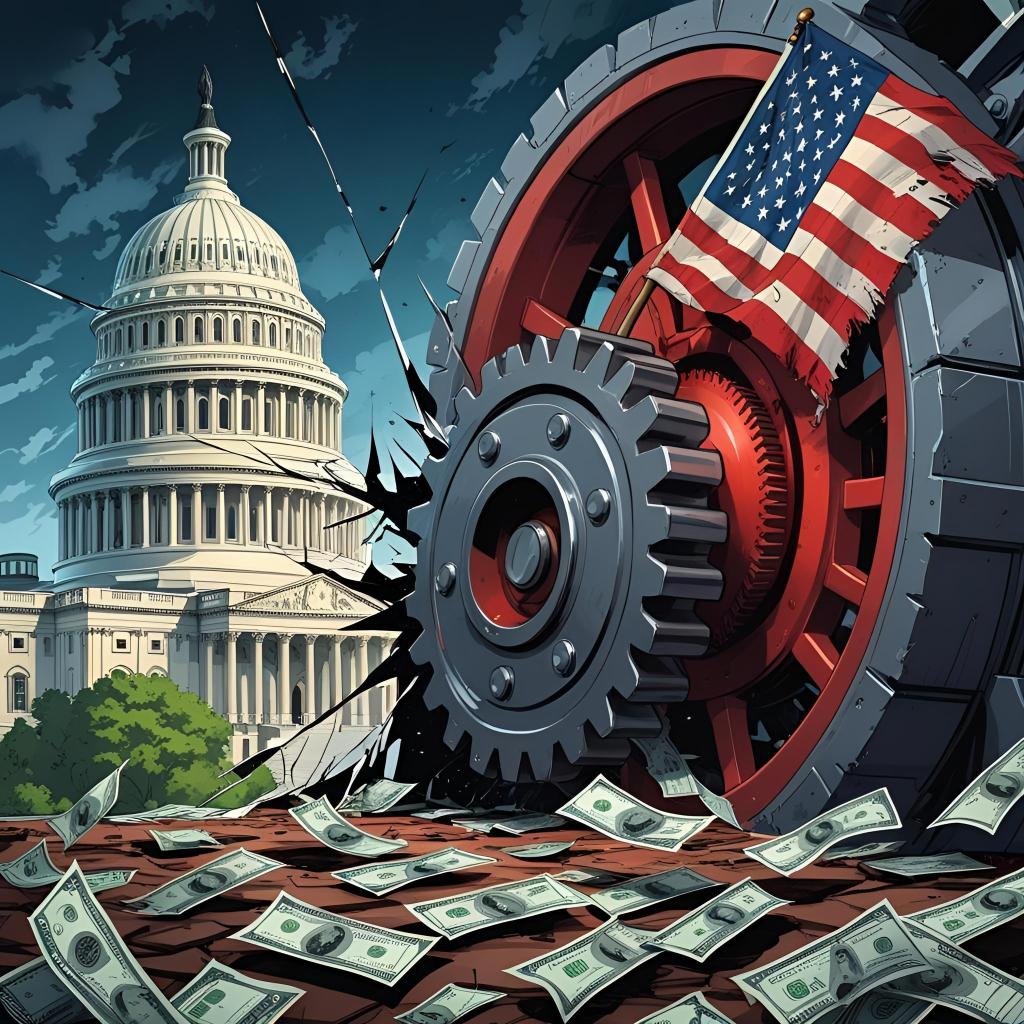
The American economy isn’t slowing by chance—it’s being destabilized from the top down. Behind modest inflation and misleading GDP headlines lies a perilous combination of erratic trade policy, fiscal sabotage, institutional erosion, and political apathy. Together, President Donald Trump and a compliant Congress have turned economic governance into a wrecking ball, swinging against the very scaffolding that holds up American resilience.
Inflation appears to be cooling, with CPI easing to 2.6% and PPI slipping 0.1%. But dig deeper: shelter costs are still surging, and insurance rates are burning holes through household budgets. At the producer level, margin compression is everywhere. These are not signs of recovery—they’re symptoms of a patient masking pain.
Manufacturing has entered a steep slide. The ISM PMI stands at 46.8%, indicating a deep contraction. Employment, new orders, and production are all falling. Industrial output grew a modest 0.3%, skewed by seasonal fluctuations in utility demand—not organic expansion. Durable goods are retreating. Factories are destaffing. This isn’t a slowdown—it’s a stall.
Labor reports suggest strength—but it’s superficial. July added 147,000 jobs, but mostly in government and construction. Private-sector hiring is flat. Labor force participation continues to fall. Real disposable income is down. Long-term joblessness is ticking up. This is economic fragility dressed as stability.
Consumers aren’t fooled. They’re pulling back from domestically produced durables and trading down across retail categories. Food and housing are absorbing a significant portion of budgets, while discretionary spending remains flat. Sentiment data shows caution—not confidence.
Bond markets are flashing red. The yield curve remains inverted—10-year yields are below 2-year yields—for over ten months. This is the same red flag that has been seen before every major recession since 1980. Meanwhile, the Fed is fractured. Governor Waller wants to cut rates immediately, while Chair Powell resists pressure from Trump, who demands liquidity but inadvertently fuels inflation.
That Q2 GDP bounce of 3.8%? Smoke and mirrors. Driven by inventory restocking and capex surges tied to tariff timing—not real consumption or business confidence. Strip away those distortions, and organic growth collapses.
At the center of it all is Trump. His tariff war has become a policy bludgeon—damaging supply chains, triggering retaliation, and inflating costs. Congress has failed to rein him in. The “One Big Beautiful Bill Act” added trillions to the deficit while slashing safety nets and padding the top 1%. The Fed’s independence is under attack over a renovation project that has become a political weapon. Immigration crackdowns are thinning the labor pool, inflating wages, and destabilizing key sectors.
And Congress? Complicit. Silent on Fed interference. Absent from trade oversight. Passive in the face of fiscal recklessness.
This is not just mismanagement. It’s economic sabotage. Growth is being strangled by contradiction. Stability is being sacrificed for optics. Policy is being weaponized against data, against institutions, and against the long-term strength of the American economy.
If current trends hold, the U.S. won’t ease into recession. It will be driven there—by design. Q1–Q2 2026 won’t be an accident of market cycles. It will be the inevitable result of political intervention, economic distortion, and legislative apathy.
This is not just a failure of policy; it is a failure of policy. It is a test of whether truth, data, and accountability still matter in the American economic system. And right now, the answer is hanging by a thread.
References
- U.S. Bureau of Labor Statistics – Employment Situation: July 2025
- Bureau of Economic Analysis – GDP Advance Estimate, Q2 2025
- U.S. Department of Commerce – Consumer Price Index (CPI), Producer Price Index (PPI): July 2025
- Institute for Supply Management – Manufacturing PMI: July 2025
- Federal Reserve Board – Monetary Policy Statements, July 2025
- Politico, “Trump’s Economic Plans Face Reality Check” – April 28, 2025
- The Wall Street Journal – “Trump vs. Powell: Fed Independence Under Fire” – July 2025
- Congressional Budget Office – Analysis of the One Big Beautiful Bill Act
- Bloomberg – “Yield Curve Inversion Hits 10-Month Mark: What It Means” – July 2025
- Reuters – “U.S. Immigration Policy Deepens Labor Shortages in Key Sectors” – June 2025
- University of Michigan Consumer Sentiment Index – July 2025
- Commentary from Lawrence Summers, Thomas Gift (UCL), and Todd Phillips (American University) on Fed independence and economic policy risks

Windmill Mousepad
Elevate your workspace with our enchanting windmill mouse pad, where a picturesque windmill rests among blooming cherry blossoms, vibrant tulips, and a tranquil creek. Designed to inspire, its serene beauty brings a touch of peace to your daily routine. CMP10012……..$7.50
 Mentonym Express