


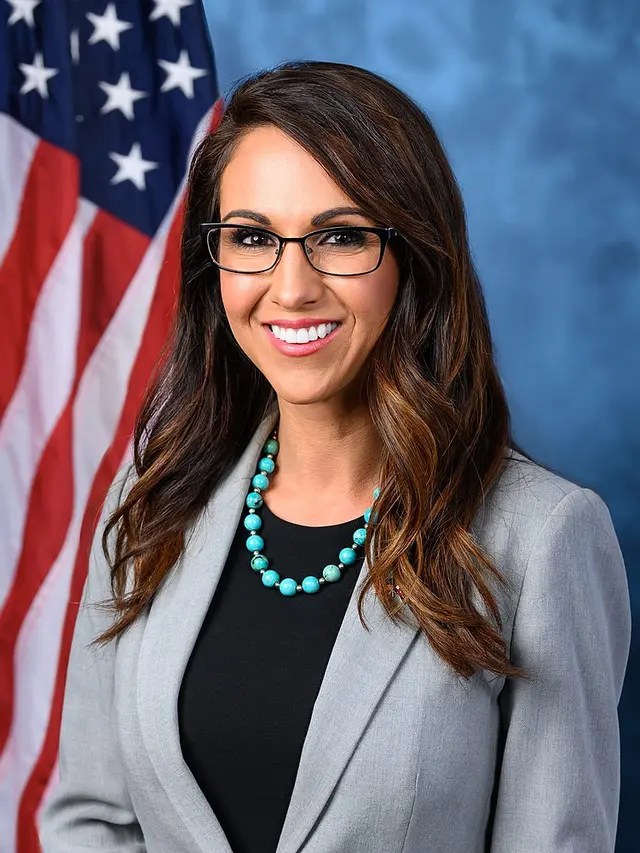
Colorado’s 2026 congressional race in the 4th District has emerged as a national litmus test for the resilience of democratic institutions. Representative Lauren Boebert’s reelection campaign embodies a volatile fusion of policy extremism, personal controversy, and procedural collapse—a challenge not just to governance, but to its very foundations.
As one of the fiercest proponents of the MAGA agenda, Boebert has amplified its theatricality and legislative consequences. She co-sponsored the “Golden Age Act of 2025,” advocating Donald Trump’s image on U.S. currency, and was instrumental in pushing through H.R. 1—the so-called “One Big Beautiful Bill.” Beneath its fanfare lay sweeping deregulations: permanent Trump-era tax cuts, revoked environmental protections, and $140 billion allocated to militarized border infrastructure. Tucked within were provisions that dismantled healthcare protections for trans Americans, loosened firearm restrictions, and stripped federal aid from undocumented immigrants.
Boebert’s education agenda reveals deeper institutional decay. Through her sponsorship of H.R. 899, which seeks to eliminate the Department of Education outright, she has framed zip-code-based schools as “tyranny” while promoting a “Parents Bill of Rights” that overrides curriculum standards, bans critical race theory, and targets LGBTQ+ inclusion. If fully enacted, her platform would strip over $100 million in federal aid from Colorado classrooms—widening achievement gaps and intensifying economic pressure. Eliminating Title I and IDEA funding would erode essential support structures, including reading specialists, tutoring, and special education, all of which are vital resources for vulnerable students. Removing free and reduced-price school meals would force struggling families to absorb grocery costs or rely on food banks, while wealthier households navigate these challenges with ease.
Voucher and charter expansions, marketed as equalizers, often require applications, transportation management, and out-of-pocket fees—barriers low-income families can’t afford. Meanwhile, affluent households supplement voucher amounts to access private enrichment programs, such as STEM labs, SAT prep, and arts camps. As federal funding shrinks, under-resourced districts cut literacy coaches and counselors first, while property-rich districts maintain or expand services. The result is stark: well-funded schools for the wealthy, austerity for everyone else.
Agriculture, a cornerstone of the district’s identity, is also under siege. Boebert’s support for deregulation, tax breaks for absentee landowners, and rollbacks of water protections disproportionately benefits agribusiness and corporate interests—while leaving small growers exposed to market volatility and environmental stress. The One Big Beautiful Bill overhauled USDA subsidies, abolishing income caps and redirecting billions to large corporations. Family-run farms now face steeper compliance costs, fewer conservation grants, and dwindling drought support.
Boebert opposed renewing the Emergency Relief Program for crop loss, voted against expanded SNAP funding for rural grocery stores, and sought to defund soil resiliency research—all while championing fossil fuel leases on federal grazing land. Her resistance to the Biden administration’s 30×30 initiative destabilized water rights across Colorado’s interbasin compacts, resulting in reduced irrigation credits and accelerated land consolidation. Her version of “freedom to farm” invites debt, ecological strain, and generational displacement.
Her political ascent has also been marked by proximity to extremist groups with white nationalist ideologies. During her 2020 campaign, she invited members of the Three Percenters to provide security at her events and appeared publicly with affiliates of the Proud Boys. Both groups were involved in the violent 2017 Unite the Right rally in Charlottesville. Her former campaign manager, Sherronna Bishop, praised the Proud Boys on air, and Boebert has never publicly disavowed these affiliations.
In 2023, Boebert was among 26 House Republicans who declined to denounce white supremacy and the Great Replacement theory. This far-right conspiracy claims white Americans are being deliberately replaced by immigrants. Her rhetoric, including claims that Democrats are “importing voters,” mirrors the theory’s central tenets.
These connections are not incidental—they’re structural. They reflect a political strategy rooted in racial grievance, historical distortion, and institutional intimidation. When elected officials normalize ties to white nationalist groups, they don’t just signal extremism—they institutionalize it.
She also invokes Christian identity as a form of political armor. At a 2022 Colorado church service, Boebert dismissed the constitutional separation of church and state as “junk,” declaring: “The church is supposed to direct the government.” This rhetoric clashes with centuries of constitutional interpretation, from Thomas Jefferson’s 1802 letter to the Danbury Baptists to the 1947 Everson ruling, which affirmed the principle of religious neutrality.
Critics see these statements as aligning with Christian nationalism—privileging a singular religious worldview while undermining pluralism. Legal scholars continue to challenge her framing on constitutional grounds.
Personal conduct further muddies the moral waters. In September 2023, Boebert was ejected from Denver’s Buell Theatre for vaping, disruptive behavior, and public groping during a performance of Beetlejuice. Surveillance captured her flipping off the staff. Weeks earlier, she condemned LGBTQ+ public events for “sexualizing family spaces.”
Legal incidents involving her family amplify the dissonance. Her ex-husband was arrested for trespassing and obstruction; her teenage son faced 22 criminal charges. Boebert herself has a prior arrest record for disorderly conduct and failure to appear in court.
Now, she seeks reelection in the 4th District with Trump’s endorsement—promising “Trump policies on steroids,” including mass deportations, fentanyl reclassification, and the dismantling of sanctuary cities. Her opponent, Navy Admiral Eileen Laubacher, is gaining momentum, but this race transcends party lines. It is a referendum on truth versus performance, principle versus brand.
Boebert’s legislative shortcuts, moral contradictions, and institutional sabotage aren’t outliers—they are the infrastructure of her political identity. In a democracy dependent on public trust and systemic integrity, the stakes have never been higher.
References
- Jefferson, Thomas. Letter to the Danbury Baptist Association (1802)
- Justice Hugo Black. Everson v. Board of Education, 330 U.S. 1 (1947)
- Boebert, Lauren. Remarks during 2022 church service in Colorado – Coverage by NPR, HuffPost, The Hill
- H.R. 1 – “One Big Beautiful Bill” (2025 legislative cycle) – Congressional records and policy analyses
- H.R. 899 – Department of Education elimination bill – Legislative archives
- Boebert campaign platform – Official materials, speeches, interviews
- Denver Buell Theatre incident (2023) – Surveillance footage and media reporting
- Colorado 4th District education funding – U.S. Department of Education estimates
- USDA subsidy modifications – Federal agriculture policy documentation
- Legal records involving Boebert and family – Public law enforcement databases
- Rep. Alexandria Ocasio-Cortez – Commentary on legislative process
- Justice Hugo Black quote – Cited extensively in constitutional law commentary
 Mentonym Express