

Washington, D.C. — A growing body of evidence points to President Donald Trump’s rhetoric and strategic decisions as the driving force behind a surge in political violence, institutional breakdown, and democratic erosion across the United States. Analysts, investigators, and national security officials say the pattern is clear: Trump didn’t just provoke chaos — he built the architecture for it.
Trump’s response to protest wasn’t passive — it was contemptuous. He mocked the millions who marched in the Women’s March, threatened military force against demonstrators mourning George Floyd, and treated climate and immigration rallies as invisible. This wasn’t neglect — it was strategic disregard. Experts say his posture fractured civic trust, delegitimized peaceful resistance, and pushed dissent toward confrontation.
“When peaceful resistance is ignored, violence becomes the language of the unheard,” said one civil rights analyst.
His rhetoric routinely crossed into incitement. From “stand back and stand by” to “fight like hell,” Trump’s words weren’t just provocative — they were operational. Rioters cited them in court. Extremists echoed them in manifestos.
He didn’t just undermine elections — he sabotaged them. He claimed fraud before votes were cast, refused to concede, pressured officials, and amplified conspiracy theories. Analysts say these actions created a permission structure for violence and delegitimized democracy itself.
He attacked the press, labeled journalists “the enemy of the people,” revoked credentials, and encouraged hostility. PEN America and the Committee to Protect Journalists have documented dozens of cases where reporters were threatened, blocked, or attacked.
“He didn’t protect free speech — he weaponized it,” said a media ethics researcher. “He punished dissent and rewarded loyalty.”
The assassination of conservative activist Charlie Kirk in 2025 has become a flashpoint. Investigators confirmed the killing was politically motivated. Steve Bannon, Trump’s former strategist, referred to Kirk as “a casualty of war” — a phrase critics say reflects the war-like framing Trump and Bannon used to mobilize their base.
“This wasn’t a metaphor,” said one political analyst. “It was admission. The war they built — with slogans like ‘retribution,’ ‘spiritual warfare,’ and ‘heads on pikes’ — made violence inevitable. Trump’s rhetoric gave it permission. Bannon’s strategy gave it structure.”
The recent targeted killing of two ICE agents has further intensified scrutiny. Investigators say the ambush was ideologically driven, carried out by individuals radicalized by anti-government rage. Experts link the attack directly to the climate of political warfare Trump and his allies cultivated.
“These agents weren’t just victims of extremism,” said a national security official. “They were casualties of a system that treats public servants as pawns in a culture war. Trump’s rhetoric didn’t just provoke opposition — it made government itself a target.”
Symbolic elements, such as MAGA hats, have become quasi-tribal uniforms. Sociologists and political scientists argue that they reinforce in-group loyalty and out-group hostility through visual cues of allegiance and confrontation.
“The cumulative effect is undeniable,” said one constitutional scholar. “Violence normalized. Protest delegitimized. Truth dismantled. Trump didn’t just provoke division — he detonated it.”
Trump built the machine. The left learned its gears. What was once incitement from the top is now insurgency from below — and the tactics he normalized are now being used to dismantle the system he built.
📅 Expanded Timeline of Escalation
- June 16, 2015 — Trump announces his presidential run, descending the Trump Tower escalator and launching a campaign built on grievance, racial provocation, and cultural resentment.
- June 17, 2015 — Dylann Roof murders nine Black parishioners in Charleston. His manifesto echoes white nationalist themes that gained traction during Trump’s rise.
- July–October 2015 — Hate crimes spike nationally. FBI data shows a measurable uptick in race-based and anti-Muslim incidents.
- November 27, 2015 — Robert Dear attacks a Planned Parenthood clinic in Colorado Springs, citing “baby parts” rhetoric amplified by right-wing media and political figures.
- December 2015 — Trump proposes a “total and complete shutdown of Muslims entering the United States,” triggering global condemnation and domestic radicalization.
- January 2016 — Armed militia occupies the Malheur National Wildlife Refuge in Oregon. The standoff is fueled by anti-government sentiment and emboldened by Trump’s anti-federal rhetoric.
- January 21, 2017 — Women’s March draws over 4 million protesters nationwide. Trump ignores the movement and later mocks its participants.
- August 2017 — Charlottesville rally turns deadly. Trump’s “very fine people on both sides” comment draws bipartisan outrage and emboldens white nationalist groups.
- May 25, 2020 — George Floyd is murdered by police. Trump threatens to deploy the military against protesters and clears Lafayette Square for a photo op.
- September 29, 2020 — During a presidential debate, Trump tells the Proud Boys to “stand back and stand by.” The group adopts the phrase as a rallying cry.
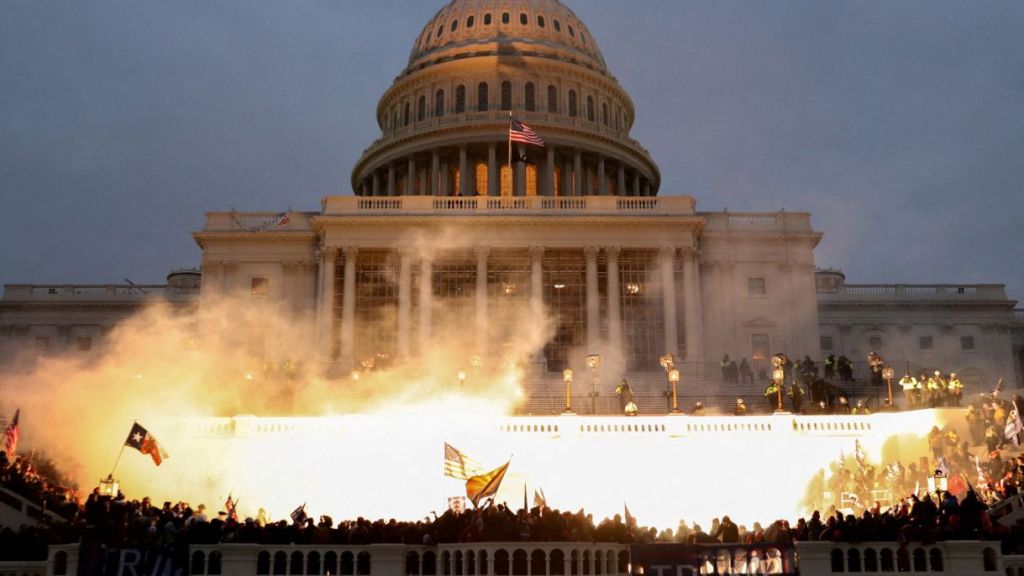
- January 6, 2021 — Trump incites a violent mob to storm the U.S. Capitol. His speech includes phrases such as “fight like hell” and “you’ll never take back your country with weakness.”
- 2021–2024 — Trump continues to claim the 2020 election was stolen. He pressures state officials, promotes conspiracy theories, and fuels distrust in democratic institutions.
- 2022–2023 — State legislatures pass dozens of anti-protest bills. Trump-aligned governors criminalize dissent and expand surveillance of activist groups.
- 2024 — Trump returns to campaign mode with slogans like “retribution,” “spiritual warfare,” and “I am your justice.” Violent rhetoric becomes normalized across MAGA media.
- August 2025 — Charlie Kirk is assassinated in a politically motivated attack. Steve Bannon calls him “a casualty of war,” framing the death as part of a broader ideological conflict.
- September 2025 — Two ICE agents are killed in a targeted ambush. DHS investigators cite ideological radicalization and anti-government rage as primary motives.
- Ongoing — Political violence continues to escalate. CSIS confirms left-wing attacks now outnumber right-wing incidents for the first time in over 30 years — a reversal driven by reactive radicalization to Trump’s presidency.
📚 References
- FBI Hate Crime Statistics (2015–2024)
- DOJ reports on Charleston and Colorado Springs attacks
- CSIS report (2025) on political violence trends
- Dan Byman, CSIS senior fellow, public statements
- Coverage of George Floyd protests and Lafayette Square incident (The Washington Post, CNN)
- Women’s March documentation (NPR, The Guardian)
- Charlottesville rally analysis (New York Times, SPLC)
- Steve Bannon’s “War Room” transcripts (Media Matters, Rolling Stone)
- MAGA hat symbolism studies (Vox, The Atlantic)
- Proud Boys quote and January 6 testimony (BBC, House Select Committee)
- Election denialism coverage (Reuters, AP)
- Policy flashpoints: Muslim ban, family separation, trans military ban (ACLU, Human Rights Watch)
- Media suppression documentation (PEN America, CPJ, Columbia Journalism Review)
- Free speech suppression: anti-protest bills, loyalty-based speech enforcement, platform pressure (The Washington Post, NPR)
- Charlie Kirk assassination analysis and Bannon’s framing (Axios, Politico)
- ICE agent ambush investigation (Department of Homeland Security, independent security analysts)
 Mentonym Express