

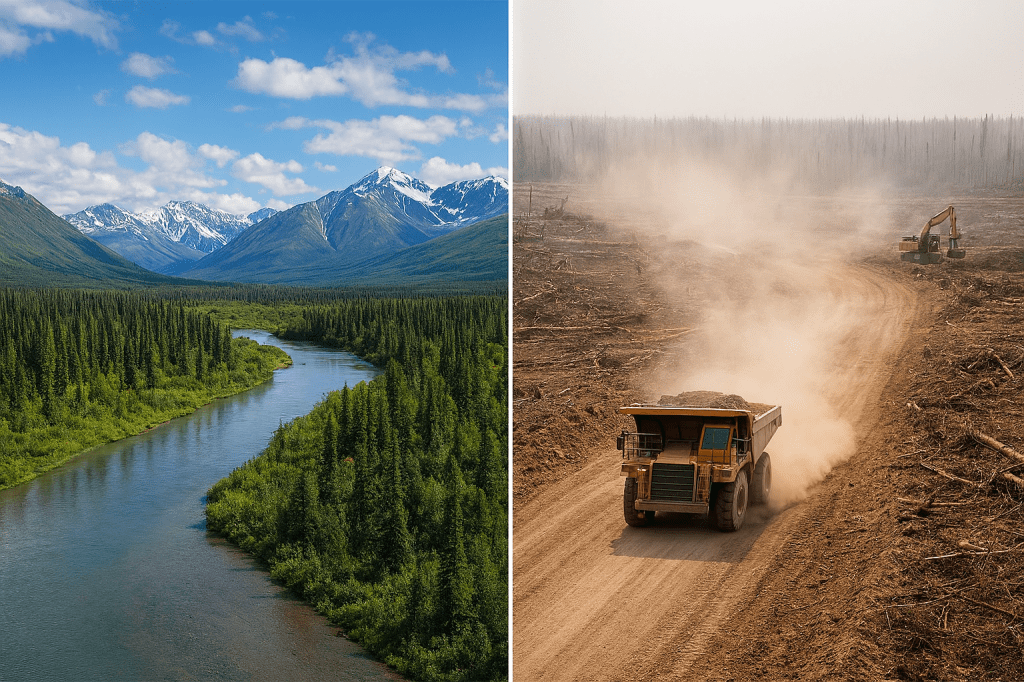

In a move that defies reason and shreds decades of conservation precedent, the Trump administration has greenlit a 211-mile industrial corridor through the heart of Alaska’s wilderness—an act of ecological vandalism masquerading as economic strategy.
The so-called Ambler Road, a mining access route slicing through Gates of the Arctic National Park and Preserve, is more than a scar on the map. It’s a wound to the soul of a landscape that has remained untouched for millennia. It’s a betrayal of the people who live in harmony with this land, and a threat to the wildlife that depend on its rhythms to survive. This isn’t infrastructure—it’s extraction. And it’s being forced through with the subtlety of a bulldozer.
Let’s be clear: this road isn’t for Alaskans. It’s for foreign mining interests. The U.S. government has taken a 10 percent stake in Trilogy Metals, a Canadian firm poised to exploit the Ambler Mining District’s copper, zinc, cobalt, and other critical minerals. The administration even invoked a rarely used clause in the 1980 Alaska National Interest Lands Conservation Act to override environmental protections and fast-track the project.
The consequences are staggering. Wildlife disruption will sever caribou migration routes and imperil salmon streams. Over 40 federally recognized tribes have voiced opposition, warning that the project threatens subsistence hunting and fishing—lifelines not just of nutrition, but of identity, tradition, and generational continuity. These aren’t abstract losses. They’re personal. They’re ancestral. They’re irreversible.
The ecological devastation is surgical and sweeping. The road will cut across nearly 3,000 streams, 11 major rivers, and 1,700 acres of wetlands. It bisects prime habitat for grizzly bears, wolves, Dall sheep, moose, wolverines, and three caribou herds. It introduces noise, dust, and light pollution that erodes the park’s wild character. And it invites motorized intrusions—ATVs, motorboats, airstrips—and the inevitable fragmentation that follows. What was once a pristine, interconnected ecosystem becomes a dissected corridor of industrial sprawl.
This is not development—it’s desecration. And it’s being sold to the public as a patriotic pivot toward mineral independence, a strategic move in the “AI arms race against China.” But the real race is against time, against climate collapse, and against the erosion of public trust in the stewardship of our lands. We are not just losing terrain—we are losing integrity.
The Ambler Road is a test. Not of engineering, but of values. Will we trade irreplaceable wilderness for short-term profit? Will we let foreign corporations dictate the fate of our national parks? Or will we rise, mobilize, and defend the last wild places with the same ferocity they deserve?
And if you need a visual metaphor for this moment, picture Donald Trump arm-in-arm with Hoggish Greedly—the cartoon villain from Captain Planet who devours ecosystems for profit. One real, one animated, both emblematic of a worldview where extraction trumps preservation and greed masquerades as governance. It’s not satire—it’s policy.
But here’s the truth: we are not powerless. We are stewards. We are protectors. We are the generation that can say “no more.” The fight for Alaska’s wilderness is not just about land—it’s about legacy. It’s about choosing reverence over recklessness, and courage over complicity. It’s about standing up for the places that cannot speak, and the people whose voices have been ignored for too long.
This isn’t just Alaska’s fight. It’s America’s. And the road to ruin must end here. Because what we protect today isn’t just land—it’s life. It’s the promise that some places will remain wild, sacred, and whole. That future generations—our children, their children, and those yet to come—will walk these trails, drink from these rivers, and witness the majesty of untouched wilderness. That they will inherit not scars, but sanctuaries.
Let this be our legacy: that when the bulldozers came, we stood firm. That when greed knocked, we answered with guardianship. That was when the wild called, we listened—and we kept it wild.
References:
- National Parks Conservation Association (NPCA), “Trump Administration Calls for Approval of Ambler Mining Road”
- U.S. Bureau of Land Management, Ambler Road Environmental Impact Statement
- Alaska Wilderness League, “Ambler Road Threatens Alaska’s Wildest Lands”
- Tribal Coalition Statements, compiled by Tanana Chiefs Conference and Native Movement
- Scientific American, “The Ambler Road Would Scar Alaska’s Wildest Lands”
- Earthjustice, “Legal Challenges to Ambler Road Permits”
 Mentonym Express