


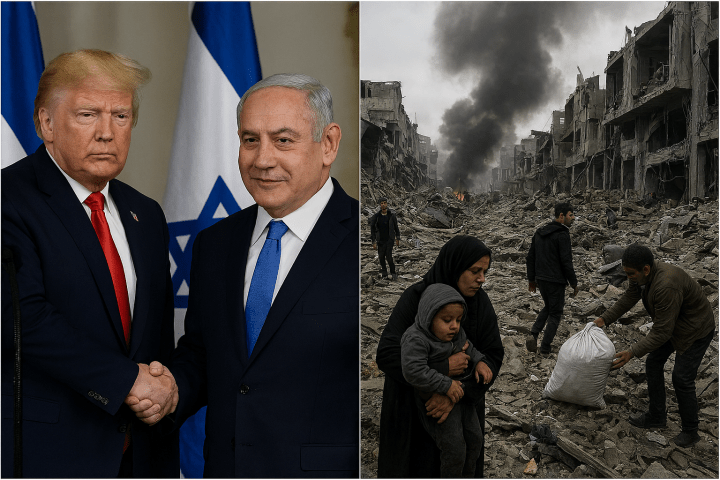
President Donald Trump reemerged on the global diplomatic stage this week, co-chairing a high-profile peace summit in Sharm El-Sheikh, Egypt, following a dramatic hostage-prisoner exchange between Israel and Hamas. The summit, attended by more than two dozen world leaders, marked a pivotal moment in the two-year conflict that began with the October 7, 2023, attacks. The ceasefire agreement, brokered in part by Trump, secured the release of all 20 living Israeli hostages and nearly 2,000 Palestinian prisoners—including 250 serving life sentences and 1,700 held without formal charges. Trump also addressed the Israeli Knesset before joining Egyptian President Abdel Fattah al-Sisi at the summit. The deal outlines military pullbacks, humanitarian aid corridors into Gaza, and a framework for continued negotiations based on Trump’s 20-point peace plan. While Trump allies have hailed the agreement as “historic,” critics argue it fails to confront the deeper structural issues that have long fueled the Israeli–Palestinian conflict.
Despite the summit’s visibility, Palestinian leaders and civil society groups have expressed deep frustration over the deal’s limitations. It offers no recognition of Palestinian statehood, no roadmap toward sovereignty, and no provisions regarding the status of East Jerusalem—long claimed by Palestinians as their future capital. Israeli settlement expansion in the West Bank continues unchecked, and the right of return for Palestinian refugees remains entirely excluded from negotiations. Although the Gaza blockade was eased to allow humanitarian aid, it remains largely intact. “This deal trades prisoners for quiet, not justice,” said one Palestinian human rights advocate. “It’s a ceasefire without a future.” Analysts warn that while the agreement may reduce immediate violence, it risks entrenching the status quo—leaving Palestinians stateless, fragmented, and under occupation or blockade.
Trump’s 20-point Gaza peace plan, unveiled as the centerpiece of the summit, has drawn sharp criticism for its emphasis on control and optics over justice and sovereignty. Key provisions include the demilitarization of Gaza, a phased Israeli withdrawal, and the installation of a technocratic transitional government—excluding Hamas entirely. The plan promises infrastructure redevelopment and humanitarian aid, but only under strict compliance conditions. It includes a hostage exchange, a remains-for-remains clause, and conditional amnesty for disarmed Hamas members. Yet nowhere in the plan is there recognition of Palestinian statehood, a resolution for East Jerusalem, or any mention of refugee rights. As one analyst put it, “It’s a ceasefire blueprint dressed up as a peace plan—designed to stabilize, not liberate.”
Trump’s earlier foray into Middle East diplomacy came in 2020 with the Abraham Accords, which normalized relations between Israel and several Arab nations, including the United Arab Emirates, Bahrain, Morocco, and Sudan. While widely publicized, foreign policy experts note that these countries were already cooperating quietly with Israel, and the accords did little to address the Israeli–Palestinian conflict. “The Abraham Accords were more about optics than outcomes,” said a former U.S. diplomat. “They formalized existing relationships but left the core conflict untouched.”
What’s become increasingly clear is that Trump’s approach to Middle East peace has consistently prioritized spectacle over substance. His deals have been heavy on ceremony and short on solutions—failing to engage with the root causes of conflict, displacement, and statelessness. The absence of Palestinian agency in these negotiations, the lack of structural reform, and the continued expansion of settlements all point to a strategy designed for headlines, not healing.
In contrast, past U.S. presidents are remembered for diplomacy rooted in substance—not performance—and often pursued at significant political cost, without personal branding or self-congratulatory fanfare.
Jimmy Carter brokered the 1978 Camp David Accords between Egypt and Israel, ending decades of war and delivering a treaty that remains in effect to this day. Carter’s efforts involved secluded negotiations, personal risk, and no campaign-style rollout. His legacy rests not on photo ops, but on a peace that has endured for nearly half a century.
Bill Clinton invested years in shuttle diplomacy, facilitating the Oslo Accords and the 1994 peace treaty between Israel and Jordan. He brought Israeli and Palestinian leaders together for direct negotiations, often absorbing political backlash at home. Clinton’s work was rooted in process, not performance—his goal was resolution, not headlines.
George H. W. Bush led a multinational coalition during the Gulf War to expel Iraqi forces from Kuwait, reshaping regional security dynamics. He resisted triumphalism, choosing coalition-building and postwar diplomacy over personal glorification. His administration laid the groundwork for the 1991 Madrid Conference, a precursor to future peace talks.
Barack Obama negotiated the Iran Nuclear Deal (JCPOA) with five other world powers, delaying Iran’s nuclear ambitions and opening diplomatic channels. The agreement was the product of years of technical negotiation and international coordination. Obama faced fierce domestic opposition but prioritized global stability over political optics.
Compared to these efforts, Trump’s record—while headline-grabbing—has been described as more transactional than transformative. His initiatives have focused on economic deals, arms sales, and symbolic gestures, often bypassing the deeper structural issues that have defined the region’s instability for decades. “Trump’s diplomacy is built for the camera, not the negotiating table,” said one former State Department official. “It’s a branding exercise, not a breakthrough.”
As the region continues to grapple with unresolved sovereignty disputes, humanitarian crises, and political fragmentation, experts say the legacy of U.S. diplomacy will be measured not by ceremonies or summits, but by durable peace and regional stability. For now, Trump’s Middle East legacy remains a work in progress—one that may be remembered more for its optics than its outcomes, and for failing to confront the underlying problems that actual peace demands.
References:
- The Abraham Accords Explained – Brookings Institution
- Camp David Accords – U.S. Department of State Office of the Historian
- Oslo Accords Overview – United Nations
- Iran Nuclear Deal (JCPOA) Summary – Arms Control Association
- [Gaza Ceasefire Summit Coverage – Al Jazeera, October 2025]
- [Hostage-Prisoner Exchange Analysis – Haaretz, October 2025]
- [Trump’s Peace Plan Review – The Guardian, January 2020]
- Middle East Eye
- Times of Israel
- Council on Foreign Relations
- NBC News
- Politico EU
- MSN News
- Axios
 Mentonym Express