


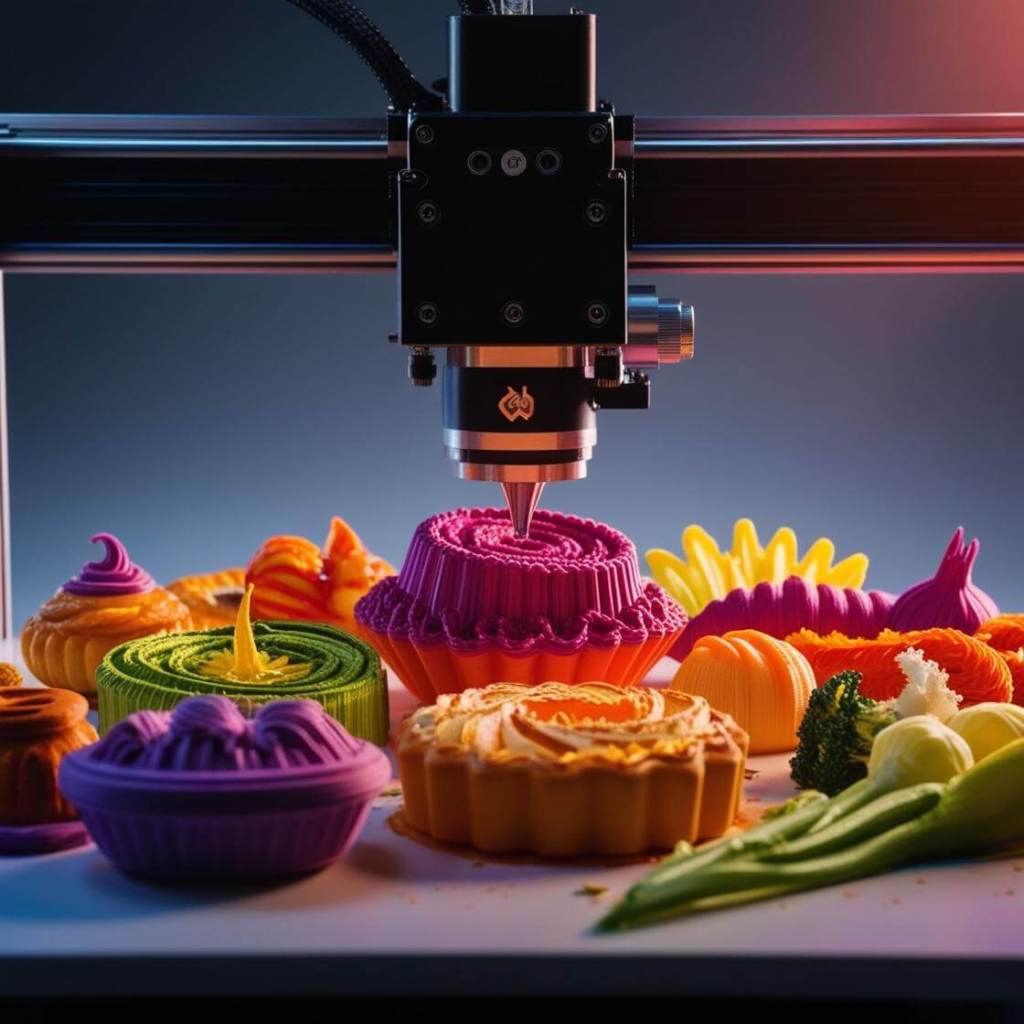

From Pixels to Plates: The Rise of 3D-Printed Food in 2025
In Star Trek, the replicator wasn’t just a machine—it was a promise. A simple voice command, a shimmer of light, and suddenly a steak dinner, a cup of Earl Grey, or even a violin appeared. No cooking. No farming. No waiting. Just nourishment, instantly.
Today, in 2025, that vision is no longer confined to science fiction. While we haven’t mastered teleportation or quantum conjuring, we’ve taken a bold step forward: meals crafted from data, printed layer by layer using real ingredients. Welcome to the world of 3D-printed food—a realm where nutrition meets innovation, and every plate becomes a story of precision, possibility, and care.
From space missions to hospital kitchens, 3D food printers are quietly revolutionizing how we nourish ourselves and others. These machines don’t just shape food—they engineer it. Texture, flavor, and nutrition are no longer bound by tradition—they’re designed, downloaded, and printed to meet real human needs.
NASA and ESA are testing these printers for long-duration missions, where printed meals reduce waste and eliminate the need for bulky resupply. Hospitals are using them to create meals tailored to patients with swallowing disorders, allergies, or chronic conditions—crafted with empathy and precision. High-end restaurants are exploring printed dishes that blend art, science, and flavor in ways conventional cooking can’t match. And in disaster zones or remote regions, portable printers offer a lifeline—producing food on-site from shelf-stable cartridges when supply chains break down.
The ingredients are real—just reformatted to suit the printer’s needs. Proteins like soy, pea, lentils, or cultured meat cells. Carbohydrates such as wheat flour, potato starch, and oats. Fats like coconut oil, cocoa butter, and sunflower oil. Flavorings from herbs, spices, and umami compounds. Binders like agar, pectin, and xanthan gum. Nutrients include vitamins, minerals, and amino acids. These components are stored in temperature-controlled cartridges and extruded with care, often followed by laser cooking or chilling to finish the dish.
At the heart of every 3D food printer is a set of ingredient cartridges—modular containers filled with edible materials that are extruded layer by layer to build a meal. These cartridges are more than just storage—they’re engineered systems that regulate flow, temperature, and ingredient integrity with surgical precision. Each cartridge holds a specific food component, such as a vegetable purée, protein gel, dough, or flavor emulsion. Ingredients are pre-processed into printable formats—smooth enough to flow through nozzles, yet structured enough to hold shape when layered. For example, a carrot cartridge might contain a fine purée stabilized with agar, while a protein cartridge could hold a soy-based gel enriched with amino acids.
Cartridges are often temperature-controlled, keeping ingredients chilled or warm depending on their properties. Some printers use smart cartridges equipped with sensors that monitor freshness, viscosity, and remaining volume. These cartridges communicate with the printer’s software to adjust extrusion rates, prevent cross-contamination, and ensure consistent output. During printing, the system selects the appropriate cartridge based on the digital recipe. A motorized plunger or pump pushes the ingredient through a nozzle, depositing it onto a build plate in precise patterns. Advanced printers can switch cartridges mid-print, allowing for multi-textured dishes—like printed ravioli with dough, filling, and sauce layered in one go. After printing, some systems apply post-processing steps, such as laser cooking, chilling, or even searing, to finish the dish. The result is a meal that’s not just shaped by data, but cooked and customized in real time.
This cartridge-based architecture enables modular, scalable, and hygienic food production, making it ideal for space missions, hospitals, and high-end culinary labs. As ingredient science evolves, expect cartridges to include everything from lab-grown meat cells to edible nanomaterials—each one a building block for programmable cuisine.
Pricing varies widely depending on the printer’s capabilities. Entry-level chocolate printers like mycusini 2.0 start around $500, while mid-range models like Cocoa Press range from $1,500 to $3,995. Professional-grade systems designed for savory dishes and multi-ingredient meals can exceed $4,000, especially those used in commercial kitchens or research labs. The average price of a consumer or prosumer 3D food printer in 2025 ranges from $1,200 to $2,500, depending on ingredient compatibility, print volume, and post-processing features.
Naturally, challenges remain. Recreating the mouthfeel of a grilled steak or flaky pastry is still difficult. Some nutrients degrade during printing or heating. Many consumers still associate printed food with artificiality or novelty. And food safety standards for printed meals are still evolving. But every obstacle is met with innovation—and a deep commitment to making food more accessible, personalized, and sustainable.
And when it comes to living—truly living—this technology holds a deeper promise. If scaled and distributed equitably, 3D food printing could help eliminate hunger worldwide. Imagine remote villages receiving digital recipes and printing meals from shelf-stable cartridges. Refugee camps equipped with solar-powered printers producing nutritious food on demand. Urban food deserts are transformed by community kitchens that print meals tailored to local needs. The potential is staggering—and profoundly human.
This isn’t just about convenience or novelty. It’s about dignity. It’s about resilience. It’s about ensuring that no child goes to bed hungry—not because we lacked food, but because we finally learned how to deliver it—smartly, sustainably, and compassionately.
The future of humanity may well be shaped by how we feed ourselves—and 3D-printed food offers a blueprint for a world where nourishment is no longer a privilege, but a programmable right. It’s a vision of abundance built on precision. A future where food is not just cooked, but coded. Not just served, but shared—across borders, across barriers, across every human need.
This is more than a technological breakthrough. It’s a humanitarian possibility. A chance to rewrite the story of hunger, inequality, and waste. A chance to build a future where food is not just a commodity, but a commitment—to life, to equity, to hope.
As AI, bioprinting, and quantum sensors converge, the future of food may include on-demand molecular meals tailored to your DNA and mood, remote culinary transmission—sending a dinner to Mars via blueprint, edible art installations that change flavor as you eat, and zero-waste kitchens where every scrap is reprinted into something new.
3D-printed food isn’t just a novelty—it’s a paradigm shift. Whether you’re an astronaut, a chef, or a patient recovering from surgery, the ability to engineer meals from data and ingredients is changing how we nourish ourselves. And in the process, it’s turning every plate into a programmable experience—one that honors both the science and the soul of what it means to eat.
References
- Frontiers in Food Science and Technology
- FoodTech Pathshala
- Unsustainable Magazine
- Precedence Research
- 3D Printed™
- Flashforge
- Eufymake
- ASME – Solving World Hunger with 3D-Printed Food
- The Borgen Project – 3D Printing Food: A New Solution to World Hunger?
- Food Reviews International – AI-Driven 3D and 4D Food Printing

Red Agate Teardrop Necklace
Red agate flat teardrop 23×15 mm pendant, with 18 Rhodium-plated sterling silver rope 1.3 mm, only two left. Good from 10/24/2025-11/24/2025
Sale price: $14.00 Regular Price $ 20.00
Use Coupon Code: S6RTPPY0ARQ1
 Mentonym Express