



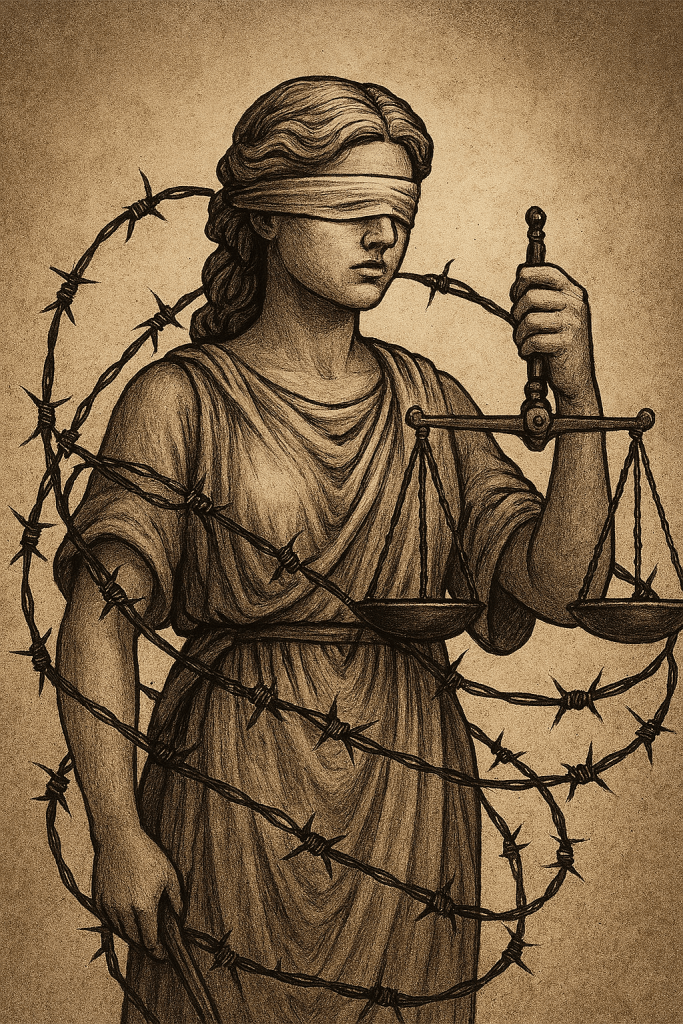
In a ruling that left many Americans stunned and disheartened, a federal appeals court declined to reinstate a lower court’s finding of probable cause that Trump officials committed criminal contempt by defying a judicial order. The decision not only shields those officials from immediate accountability—it signals a deeper institutional collapse in the face of executive defiance, and a growing fear that the rule of law is being hollowed out from within.
The case centers on a 2024 injunction issued by U.S. District Judge James Boasberg, who ordered Trump officials to halt deportations of certain Venezuelan migrants under the rarely invoked Alien Enemies Act. Despite the order, deportations continued—including transfers to a notorious prison in El Salvador—prompting Boasberg to declare that there was probable cause to believe officials had violated his directive.
The appeals court, however, ruled that Boasberg’s contempt finding was procedurally premature. While the judge retains authority to investigate further, the ruling effectively neuters judicial enforcement—again. For families torn apart by deportation flights, and for whistleblowers who risked everything to expose defiance, this ruling feels like abandonment. It’s not just a legal technicality—it’s a human cost. But it’s also a call to action.
Attorney General Pamela Bondi, a loyal Trump ally, celebrated the decision as a “MAJOR victory” for the administration’s deportation agenda. But legal experts warn that the real story is the judiciary’s growing unwillingness to enforce its own orders. “Contempt without consequence is contempt for the Constitution,” said one analyst. “And when courts back down, they don’t just lose a case—they lose their credibility.”
This isn’t an isolated incident. The Trump administration has defied or circumvented over one-third of federal court orders issued against it. In at least 57 out of 165 cases, officials delayed, dodged, or outright ignored judicial rulings. Among the most striking examples: a judge ordered full emergency food aid under SNAP, and Trump officials refused; the Supreme Court ruled a man was wrongly deported, and Trump’s team shrugged; Trump criminalized flag burning—defying two Supreme Court rulings protecting it as free speech.
And what has Congress done? Nothing. No subpoenas with teeth. No funding threats. No impeachment proceedings. Just sternly worded letters and performative outrage. The legislative branch, designed to check executive power, has instead become a spectator to its erosion. For those who still believe in democratic accountability, this silence feels like betrayal. For those directly harmed, it feels like abandonment by the very institutions sworn to protect them. But for all of us, it must become a turning point.
At the heart of this defiance is a legal worldview that has quietly become the cornerstone of Trump’s governing philosophy: the Unitary Executive Theory—and its dangers cannot be overstated.
The Unitary Executive Theory: A Legal Trojan Horse for Authoritarianism
In simple terms, the unitary executive theory asserts that the president controls the entire executive branch—and can override, ignore, or dismantle oversight from Congress and the courts. But in Trump’s hands, it has become far more than a theory. It is a weaponized doctrine of domination—a legal framework used to dismantle accountability, punish dissent, and consolidate power.
Trump’s use of the unitary executive theory has justified ignoring court orders under the guise of “national security,” firing watchdogs who investigate corruption, claiming immunity from prosecution, issuing sweeping executive orders that override Congress, treating judicial rulings as optional, and perhaps most dangerously: using the machinery of government to target perceived enemies.
Under this doctrine, the line between law enforcement and political retribution begins to blur. Critics of the administration—whether journalists, whistleblowers, civil servants, or political opponents—have found themselves investigated, surveilled, or publicly smeared. Agencies meant to serve the public become tools of retaliation. Loyalty replaces legality. Dissent becomes a liability.
This isn’t just a legal theory—it’s a power grab with a law degree. And under Trump, it has become the operating system of executive lawlessness.
Legal scholars have warned for years that the unitary executive theory, taken to extremes, dismantles the very architecture of American democracy. It invites impunity. It normalizes defiance. It weaponizes the state against dissent. And it leaves courts and Congress scrambling to respond—if they respond at all.
When courts issue orders and the executive branch shrugs, the balance of power collapses. The judiciary becomes a suggestion box, not a safeguard. Lawlessness ordered from the top becomes precedent. Checks and balances don’t work if one branch gets a pass. And Congress? It’s watching from the sidelines, paralyzed by fear or complicity.
The result is a slow-motion constitutional crisis—one where the institutions designed to protect democracy are too timid to act. But this moment is not just a warning. It’s a summons.
This case isn’t just about deportations. It’s about whether the rule of law still rules. Whether courts can enforce. Whether Congress can confront. Whether the Constitution still binds—or merely begs.
Because if the courts won’t stand up, and Congress won’t step in, the Constitution won’t stand at all. And the people—those who believed in justice, who trusted the system to protect them—will be left with nothing but the memory of what democracy once promised.
But memory is not surrender. It is fuel. And from that memory, we must build resolve.
We must demand courage from our courts. Accountability from our lawmakers. And clarity from our media. We must speak for those silenced, protect those targeted, and remind every institution that the Constitution is not a relic—it is a living document, a responsibility. This is not the end of democracy. It is the moment we decide whether it continues.
But Trump doesn’t act alone. His defiance is scaffolded by enablers—officials who carry out unlawful orders, lawmakers who refuse to confront him, and media figures who normalize the erosion of democratic norms. To rein in Trump, we must remove those who empower his abuses. That means confronting not just the figure at the top, but the machinery beneath him: the appointees, the loyalists, the silence-makers.
Accountability isn’t just about one man. It’s about dismantling the infrastructure of impunity. And that starts with naming it, challenging it, and replacing it—before it replaces democracy itself.
Sources:
Washington Post analysis of Trump-era court defiance
Reuters coverage of appeals court ruling on contempt
Legal commentary on unitary executive theory
SCOTUS decisions on flag burning and executive overreach
Pam Bondi’s public statement on social media
ABC News – Trump and the ‘unitary executive’: The presidential power theory driving his 2nd term
Democracy Docket – What Is Unitary Executive Theory? How is Trump Using It to Push His Agenda?
NPR / OPB – Trump has used government powers to target more than 100 perceived enemies
ACLU – Statement on Trump Administration’s Memorandum Targeting Political Opponents
El País – Sowing Distrust to Gain Power
 Mentonym Express