


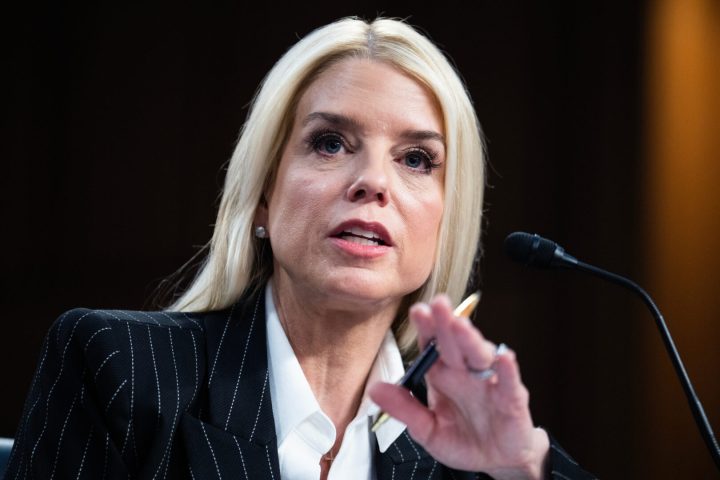
Washington, D.C. — Attorney General Pam Bondi is under intensifying scrutiny for her handling of high‑profile cases, her approach to voting rights, and her ties to corporate interests. Critics argue her record reveals a consistent pattern of incompetence, politicization, and misplaced loyalty that undermines the integrity of the Justice Department.
Bondi, a longtime ally of President Trump, has been accused of elevating loyalty to him above impartial enforcement of the law. Observers point to her decision as Florida’s Attorney General to drop investigations into Trump University after receiving campaign donations, saying it foreshadowed her current role in Washington.
Her handling of the Jeffrey Epstein scandal drew sharp rebuke from lawmakers and victims’ advocates. Bondi refused to fully release documents mandated by Congress, prompting accusations that she broke the law and shielded influential figures connected to Epstein. Survivors said her actions undermined transparency and delayed justice. For many victims, this was not just a bureaucratic failure — it was a painful reminder that powerful interests can still silence their voices.
Opponents also accuse Bondi of weaponizing the Justice Department against Trump’s perceived enemies. Reports suggest she selectively targeted political opponents while blocking oversight efforts aimed at administration officials. Advocacy groups argue that this eroded democratic norms and chilled dissent. For journalists, whistleblowers, and activists, her actions created an atmosphere of fear in which speaking truth to power carried personal risk.
Bondi’s legal strategy has raised questions of hypocrisy. She pursued litigation against California’s Proposition 50, a measure designed to suspend corrupt officials without pay, but declined to act on documented abuses in Texas, including voter suppression controversies. Analysts say this selective approach reflected partisan priorities rather than impartial justice. Communities in Texas that faced barriers to voting were left without federal protection, deepening feelings of neglect and disenfranchisement.
Her record on voting rights has drawn sharp criticism from civil rights groups and election watchdogs. Bondi consistently supported measures that made it harder for marginalized communities to cast ballots. She backed restrictive voter ID laws that disproportionately affected low‑income voters, students, and communities of color. She opposed reforms that would have expanded mail‑in voting access for seniors, rural voters, and working families. Watchdog groups also accuse her of suppressing transparency initiatives, keeping voters in the dark about corruption and misconduct. In addition, Bondi aligned herself with Trump’s false claims about widespread voter fraud, despite repeated court rulings and bipartisan election officials confirming the integrity of the process. Analysts say her actions reflect a deliberate strategy: restricting access to the ballot, limiting transparency, and spreading doubt about democratic institutions. For everyday citizens, this meant diminished voices, shaken trust in democracy, and undermined rights.
Bondi’s tenure has also been clouded by allegations of conflicts of interest. Senators and watchdog groups raised concerns about her close ties to lobbying firms and corporate donors, questioning whether her decisions as Attorney General were influenced by these relationships. Reports indicate she maintained connections with firms representing industries that benefited from her office’s selective enforcement. Critics argue that her legal actions often aligned with corporate interests rather than public accountability. For example, while aggressively pursuing litigation against California’s Proposition 50, she declined to act on corruption scandals in Texas, where powerful business allies were implicated. Analysts say this pattern reflects a broader issue of corporate favoritism. Bondi’s willingness to shield specific industries and political allies, while targeting opponents, fueled accusations that she was using the Justice Department not as a neutral arbiter of justice but as a tool to protect entrenched interests. For ordinary Americans, this raised painful questions: whose interests were really being defended, and who was left behind?
Most troubling to critics is Bondi’s repeated assertion that loyalty to Trump defines her role as Attorney General. By equating allegiance to a political figure with constitutional duty, she has made clear that her loyalty lies with Trump — not with the Constitution. Legal experts argue this mindset makes her fundamentally unfit to serve. “The Constitution demands impartiality and independence,” one scholar noted. “When an Attorney General treats loyalty to a president as more important than loyalty to the Constitution itself, the office ceases to protect the people and begins to protect power.”
Legal scholars and advocacy organizations say Bondi’s record demonstrates a consistent pattern of undermining the rule of law. For many, her tenure represents not just incompetence but a betrayal of the trust citizens place in their government to protect fairness, transparency, and accountability.
References:
- USA Today – Bondi accused of contempt in Epstein files release
- NPR – Lawmakers threaten contempt over incomplete Epstein files
- Newsweek – Florida Bar complaint against Bondi
- MSN – Bondi’s selective lawsuits
- The List – Bondi’s politicized DOJ record
- Variety – Bondi conflicts of interest
- Newsweek – Bondi’s approval rating collapse

Cat Scratch Post
The cat scratch post is in antique gold plating, with a pewter double-sided design, on a gold-plated, nickel-free necklace. The outside diameter is 21 mm, and the lid is 2mm. J10046…….$15.00
 Mentonym Express