


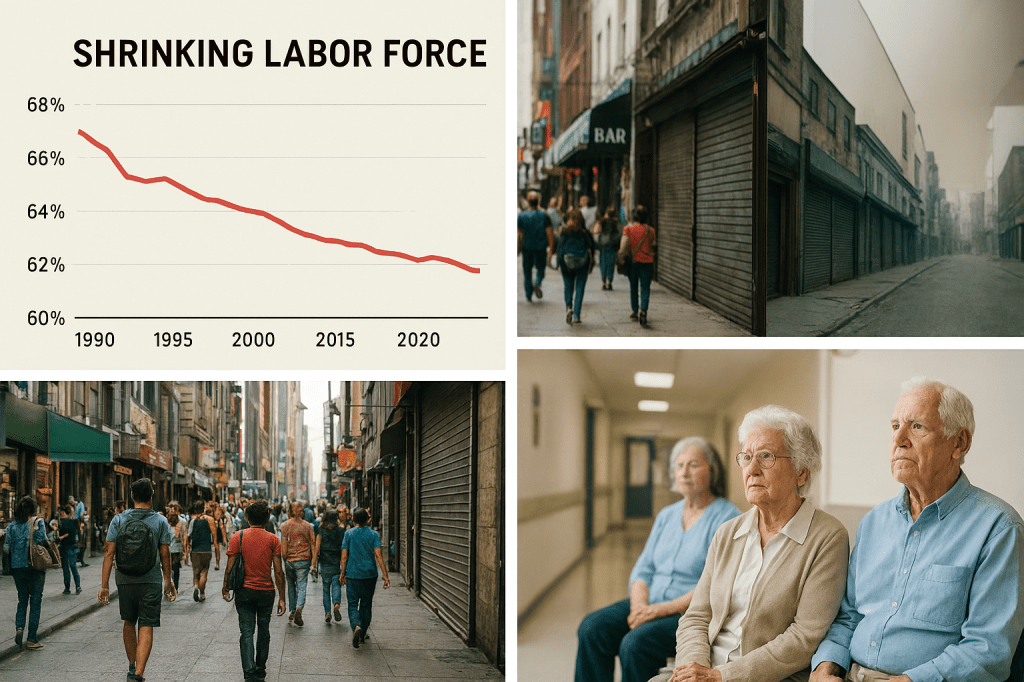
If immigration to the United States were halted entirely or significantly reduced under federal policy, economists and demographers warn of sweeping consequences that could reshape the nation’s economy, workforce, and demographics for decades. Such a dramatic shift would be unprecedented — and the stakes could not be higher. Yet within these warnings lies a reminder: immigration has always been one of America’s greatest strengths, and protecting it means protecting the nation’s future.
Immigration has long been a driving force behind U.S. economic expansion, fueling both workforce growth and consumer demand. Halting immigration entirely or sharply reducing it would strike at the core of this engine, slowing GDP and weakening global competitiveness. The labor force has grown primarily because of immigration, with immigrants and their children accounting for most of the nation’s population growth over the past two decades. Without new arrivals, the workforce would contract, leaving fewer people to fill jobs, pay taxes, and support retirees. “Immigration is not just about filling low‑wage jobs,” said one economic analyst. “It’s about sustaining the size of the labor force itself. Without it, the U.S. economy simply cannot grow at the same pace.” Immigrants contribute an estimated $652 billion in annual taxes, meaning a halt or reduction would shrink the revenue base that funds public services, infrastructure, and entitlement programs. This fiscal gap would widen as the population ages and dependency ratios rise. Immigrants are also consumers, buying homes, cars, food, and services that drive business growth. Without immigration, consumer markets would stagnate, particularly in fast‑growing urban areas where immigrant communities have been central to revitalization. Cities such as New York, Los Angeles, Houston, and Miami — all heavily reliant on immigrant populations — would feel the slowdown first. At the same time, smaller communities in the Midwest and South would also suffer. Economists caution that halting immigration entirely or significantly reducing it would not only slow domestic growth but also erode America’s position in the global economy. Immigration, far from being a liability, remains one of the nation’s greatest assets.
The most immediate and visible impact would be felt in the labor market. Shortages already straining key sectors would intensify, creating ripple effects across the economy. Immigrant workers make up a large share of the agricultural workforce, particularly in harvesting fruits, vegetables, and other labor‑intensive crops. Without them, farmers warn that fields would go unharvested, leading to food supply disruptions and higher grocery prices. “We’re talking about crops rotting in the fields,” said one farm industry representative. “Domestic labor alone cannot meet the demand.” The construction industry also relies heavily on immigrant labor for both skilled and unskilled positions. A halt or reduction in immigration would mean fewer workers to build homes, offices, and infrastructure projects, slowing housing development, driving up costs, and worsening the nation’s housing shortage. Hospitals, nursing homes, and home‑care agencies depend on immigrant workers to fill critical roles as nurses, aides, and support staff. With the U.S. population aging rapidly, demand for elder care is rising. Without immigrant labor, staffing shortages could reach crisis levels, leaving vulnerable populations without adequate care. Restaurants, hotels, and cleaning services also rely on immigrant workers, meaning fewer staff, shorter hours, reduced services, and higher prices for consumers. Beyond manual labor, immigrants play a vital role in specialized industries such as technology, engineering, and scientific research. Cutting off immigration would shrink the talent pool, making it harder for companies to recruit skilled workers and remain competitive globally. Severe labor shortages would not only disrupt individual industries but also cascade into broader economic instability. Yet history shows that immigrants have always stepped forward to fill gaps, build, heal, and innovate. Their contributions remind us that America’s strength is built on the hands and hearts of those who come seeking opportunity.
With fewer workers available, businesses would face higher labor costs and reduced capacity. Economists say this would push prices up in sectors such as food, housing, and personal services, leaving consumers to absorb the impact. Demographers warn that halting immigration entirely or significantly reducing it would accelerate one of the most pressing challenges facing the United States: an aging population. With birth rates below replacement level, immigration has become the primary source of population growth. Without it, the country would face a demographic shift that places enormous pressure on public finances and social programs. The economy depends on a steady influx of working‑age adults to sustain productivity and tax revenue. Without immigration, the labor force would shrink, leaving fewer workers to support a growing number of retirees. Economists note that this imbalance would reduce payroll tax contributions, the lifeblood of Social Security and Medicare. Social Security and Medicare are already projected to face funding shortfalls in the coming decades. Cutting off immigration would accelerate those deficits, as fewer workers contribute to the system while more retirees draw benefits. “The math is simple,” said one fiscal policy expert. “Fewer workers and more retirees mean the system runs out of money faster.”An aging population also drives higher demand for healthcare services, particularly elder care. Without immigrant workers to fill roles in hospitals, nursing homes, and home‑care agencies, the system could face staffing crises just as demand peaks. This double strain — more patients, fewer caregivers — would leave vulnerable populations at risk. Sun Belt states like Florida and Arizona, with large retiree populations, would feel the fiscal and healthcare strain most acutely. Rural areas already struggling with healthcare access could see facilities close due to staffing shortages. At the same time,
Immigrants have historically played an outsized role in American innovation, founding companies, filing patents, and driving technological advancement. A halt or significant reduction in immigration could reduce the pipeline of scientists, engineers, and entrepreneurs. “America’s competitive edge has always been tied to its ability to attract global talent,” said a technology policy expert. “Closing that door would have long‑term consequences for innovation.” Beyond agriculture, construction, and service industries, experts warn that halting immigration would strike at the heart of America’s high‑tech and specialized sectors. These industries depend heavily on immigrant talent to sustain innovation, research, and global competitiveness. Immigrants make up a significant share of workers in science, technology, engineering, and mathematics (STEM) fields. In Silicon Valley, for example, more than half of tech startups have at least one immigrant founder. Cutting off immigration would shrink the talent pipeline, leaving companies struggling to fill critical roles in software development, engineering, and data science. “The U.S. has long relied on global talent to drive its tech sector,” said a technology policy analyst. “Without immigration, the innovation engine slows down.” Universities and research institutions depend on international students and scholars, many of whom remain in the U.S. to contribute to cutting‑edge projects.
Even if immigration is only significantly reduced rather than eliminated, experts warn that the consequences would be structural and long‑lasting. Slower growth becomes permanent once the labor force shrinks, and reversing the trend is extremely difficult. Persistent labor shortages may force businesses to relocate or automate, leaving lasting scars on local economies. Fewer workers supporting more retirees deepens fiscal strain on entitlement programs. Reductions today mean fewer startups and breakthroughs tomorrow, weakening the innovation pipeline. Competitor nations that welcome talent gain an edge over the U.S. Even a significant reduction sets off long‑term consequences that compound over time — slower growth, deeper shortages, fiscal strain, and diminished global competitiveness. Once those demographic and economic shifts take hold, they are extremely difficult to reverse. The takeaway is that America still has a choice: to embrace immigration as a source of renewal, to welcome talent and families who strengthen the nation, and to ensure that the future is not defined by decline but by resilience and hope.
Analysts emphasize that the full impact of halting immigration entirely or significantly reducing it would not be immediate, but it would be irreversible. Over time, the United States would become a smaller, older, and slower‑growing nation, with diminished global competitiveness. Experts agree that such a policy would inflict economic, demographic, and social damage that compounds over time, reshaping the nation’s future far beyond the immediate political debate. And behind every statistic are human stories — families separated, communities weakened, and opportunities lost. Immigration is not just about economics; it is about people, progress, and the promise of a stronger, more compassionate America.
References:
- Axios – Trump immigration crackdown ripples through economy
- Econofact – How tighter curbs on immigration impact the U.S. economy
- Congressional Research – The effects of immigration on the U.S. economy
- American Immigration Council – Entrepreneurship & Innovation
- Congressional Research – Immigrant entrepreneurs bring jobs and innovation
- NBER – Immigrant entrepreneurship in the U.S.
- Federal Reserve Bank of San Francisco – Immigration and changes in labor force demographics
- Federal Reserve Bank of St. Louis – Immigrant talent in the U.S. labor force
- Bureau of Labor Statistics – Foreign-born workers: Labor force characteristics
- Migration Policy Institute – Immigrants and the U.S. economy
- Congressional Research – Immigration facts: The positive economic impact of immigration
- Council on Foreign Relations – How does immigration affect the U.S. economy?

Holiday Candle Collection
Celebrate the season with our hand‑poured soy candles, each crafted to capture the warmth and nostalgia of the holidays. This collection features three unique fragrances, paired with festive jar designs, making them perfect for gifting or cozy winter nights.
Was $35, now just $26.25
Use Discount Code: 4P4KY00AF3F1
 Mentonym Express