



WASHINGTON — A recent statement circulated by the Department of Homeland Security claiming that Immigration and Customs Enforcement officers possess “federal immunity in the conduct of their duties” has drawn swift and forceful criticism from legal scholars, civil rights attorneys, and former federal prosecutors. They argue the message dramatically overstates the law and risks misleading the public about the limits of federal authority. The statement, shared on DHS social channels and amplified by senior administration adviser Stephen Miller, declared: “To all ICE officers: You have federal immunity in the conduct of your duties. Anybody who lays a hand on you, tries to stop you, or obstructs you is committing a felony. You have immunity to perform your duties, and no one—no city official, no state official, no illegal alien, no leftist agitator or domestic insurrectionist—can prevent you from fulfilling your legal obligations and duties. The Department of Justice has made clear that if officials cross that line into obstruction, into criminal conspiracy against the United States or against ICE officers, then they will face justice.”
Legal experts say the message is not only inflammatory but legally false. ICE officers do not have blanket federal immunity. No federal officer does. The Supreme Court has repeatedly affirmed that federal agents can be investigated, charged, and prosecuted by states when they exceed their lawful authority. The DHS statement, they warn, misrepresents the law and risks giving federal officers a dangerous and unfounded sense of impunity — a concern made painfully urgent by the killing of Renee Nicole Good in Minneapolis.
The legal doctrine at issue is Supremacy Clause immunity, a narrow protection that applies only when federal officers are performing a legitimate federal duty, and their actions are objectively reasonable. Courts have consistently held that this protection does not apply when an officer’s conduct exceeds lawful authority. State officials also retain the power to investigate and charge federal agents in cases involving unjustified force, though such cases may be moved to federal court for review. “This is not a get‑out‑of‑jail‑free card,” said a constitutional law professor. “It’s a procedural safeguard, not a shield from accountability.”
The DHS statement arrives amid heightened scrutiny of federal enforcement actions and growing tension between federal agencies and state governments over immigration policy. That tension has taken on a deeply human dimension in Minnesota, where the fatal shooting of a Minneapolis woman has become the center of a widening legal and political confrontation — and a source of profound grief for a family now navigating the unthinkable.
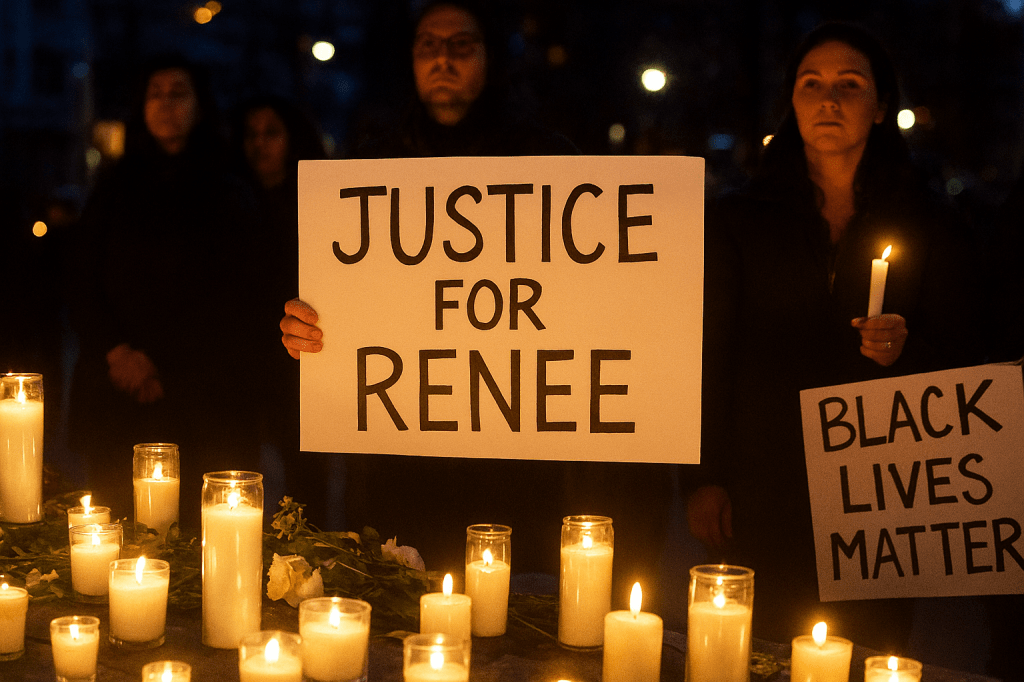
Renee Nicole Good, a 37‑year‑old U.S. citizen, mother of three, poet, writer, substitute teacher, and recent Minnesota resident, was killed by an ICE agent during a federal operation on January 7, 2026. Her death has become a national flashpoint, intensifying scrutiny of DHS operations and directly challenging the department’s claims of “federal immunity.” Good had recently moved to Minneapolis with her partner and children, seeking stability after the sudden death of her husband in 2023. Family members describe her as compassionate, artistic, and deeply devoted to her children — a woman rebuilding her life after loss, not someone entangled in any criminal investigation. She was not the subject of any ICE warrant or enforcement action.
Her killing sparked nationwide protests, vigils, and multiple state lawsuits challenging DHS deployments. Across Minneapolis, vigils have grown into something larger than grief — a collective insistence that accountability is still possible, and that one woman’s life can galvanize a community to demand better. Those who knew her say Renee carried a quiet strength — the kind that survives loss, raises children with tenderness, and still finds room for art. Her life, they say, deserves to be remembered for its fullness, not reduced to the moment it was taken.
Minnesota officials have openly disputed DHS claims that the shooting was an act of self‑defense, pointing to video evidence they say contradicts federal accounts. Community groups and Good’s family emphasize that she was not a criminal suspect and was not being targeted for arrest — a fact that has only deepened the sense of injustice surrounding her death.
Minnesota authorities are conducting active investigations into the shooting, which occurred during an ICE enforcement operation in a Minneapolis neighborhood. According to state officials, multiple agencies — including the Bureau of Criminal Apprehension and local prosecutors — are reviewing body‑camera footage, eyewitness accounts, and forensic evidence to determine whether the ICE officer’s actions were justified under state law. Minnesota’s inquiry has become a focal point in the national conversation because it directly tests DHS’s assertion that ICE officers cannot be prosecuted by states. “We investigate every use of force in our jurisdiction,” one Minnesota prosecutor said. “No agency is exempt from that process.” For many Minnesotans, the investigation is not just a legal obligation but a moral one — an effort to bring clarity and accountability to a tragedy that has left a family shattered.
The investigation began on Day 1, when Good was shot by an ICE officer during a federal operation. Local police secured the scene and notified state authorities. On Day 2, the Minnesota Bureau of Criminal Apprehension launched a formal investigation. By Day 3, investigators were analyzing body‑camera footage showing Good turning her steering wheel away from the agent seconds before shots were fired. On Day 4, DHS issued its “federal immunity” messaging, raising immediate concern among Minnesota officials, who stressed that state law applies to all uses of force within the state. On Day 5, county attorneys reaffirmed that their investigation would continue regardless of DHS statements asserting federal immunity. Day 6 brought federal–state tensions as federal officials raised jurisdictional questions, while Minnesota insisted the investigation would proceed under state law. On Day 7, ballistic and forensic materials were sent to independent labs to ensure impartial analysis. Prosecutors say a charging decision will be made only after the full investigative file is complete and that DHS statements have no bearing on Minnesota’s legal obligations.
The debate over federal authority has intensified under the leadership of Kristi Noem, now serving as Secretary of Homeland Security. Her appointment has revived earlier controversies from her tenure as governor of South Dakota, where multiple attorneys in the state Attorney General’s Office resigned after alleging political pressure to pursue investigations aligned with her office’s narratives. The concerns in Minnesota have been amplified by Noem’s history in South Dakota, where multiple attorneys resigned after alleging political pressure from her office — a pattern critics fear may now be influencing DHS. Now, as head of DHS, Noem oversees the agencies issuing sweeping statements about “federal immunity.” Critics argue that the pattern of disputes over legal independence in South Dakota raises questions about how DHS is approaching sensitive legal claims — especially as Minnesota investigates the killing of Renee Good. Noem denies any wrongdoing, but the combination of past controversies, the current DHS messaging, and the active Minnesota investigation has intensified calls for transparency. For Good’s family, these questions are not abstract; they are tied to the hope that someone, somewhere in the system, will acknowledge what happened and why.
The assertion that ICE officers possess sweeping “federal immunity” collapses under legal reality. Federal officers remain accountable to the Constitution, federal statutes, and — when they exceed their authority — state criminal law. The Minnesota investigation underscores that point in real time. With Secretary Noem at the helm of DHS, critics say the department’s messaging echoes earlier disputes over legal independence that marked her tenure in South Dakota. While the circumstances differ, the underlying tension remains the same: the attempt to frame legal authority in absolute terms, even when the law itself is conditional and limited. “Accountability is not optional,” said a former DOJ official. “And no official, federal or state, gets to declare themselves above the law.” For those mourning Renee Good, accountability is more than a legal principle — it is a belief that justice, even when delayed, is still worth fighting for. Her story has become a reminder that the law is not an abstract system but a promise we make to one another: that every life has value, that every loss deserves truth, and that even in moments of profound injustice, communities can rise with clarity, courage, and the conviction that change is still possible.
References
https://www.supremecourt.gov
https://www.justice.gov
https://www.dhs.gov
https://www.ice.gov
https://www.revisor.mn.gov/statutes
(ag.state.mn.us in Bing)
https://www.minnpost.com
https://www.startribune.com
https://www.aclu.org
(law.cornell.edu in Bing)
https://www.mncourts.gov

2 pack Cards with Yellow Holder
Bring timeless fun to your home with high‑quality playing cards built for smooth shuffling and long‑lasting play. Each handcrafted PLA case securely holds two sealed trading card packs and comes in vibrant colors like Green, Teal, Silver, Gold, Yellow, Blue, Red, and Purple. The included packs make this a ready‑to‑go collectible or gift for any fan. Perfect for game nights, collectors, or anyone who wants a unique, display‑worthy way to enjoy their card Regular price $16.00
 Mentonym Express