


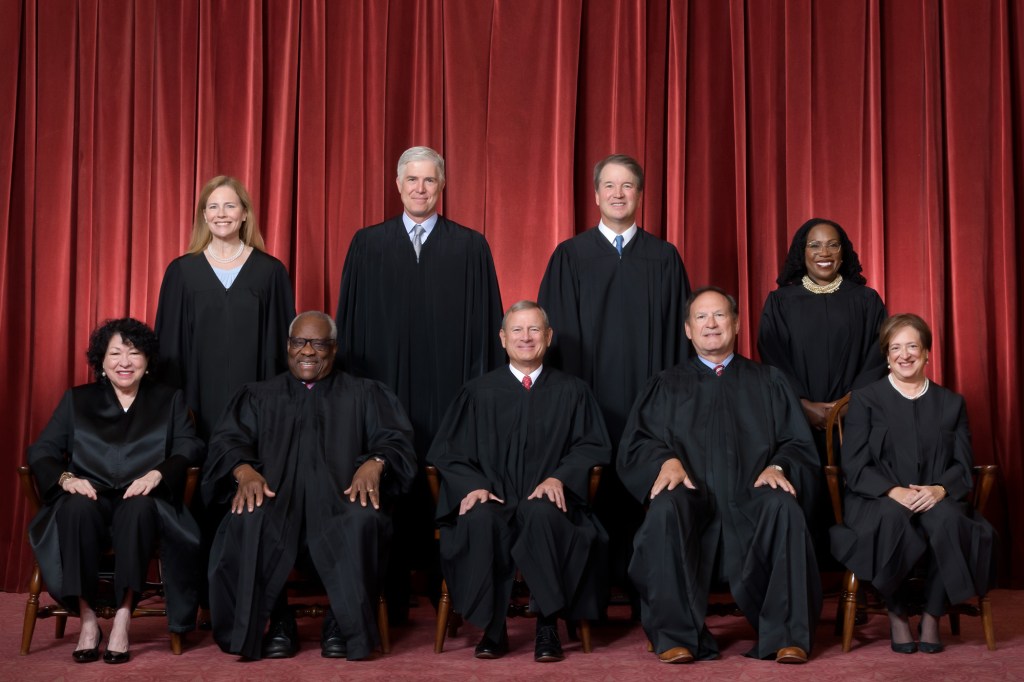
The Dark Chamber of Loyalty: How the Supreme Court Became Trump’s Personal Law Firm
The Roberts Court has abandoned its constitutional oath. In its place stands a loyalty test—one that bends precedent, discards legal fidelity, and rewrites the rules to serve one man: Donald Trump. As the Court dismantled the final firewall against authoritarian power, President Joe Biden stood by. He refused to reinforce it. Refused to confront it. Refused to act.
In a 6–3 ruling, the Court declared that presidents enjoy immunity for “official acts.” Justice Sonia Sotomayor warned that this creates a “law-free zone around the president.” Chief Justice John Roberts called it “farsighted.” Critics call it a coronation. Biden’s response? Silence. No reform. No challenge. Just deference while the Constitution was redefined.
Since returning to office, Trump has petitioned the Court 23 times—winning 17. Many rulings arrived with little explanation, some just a few pages long. Even Trump-appointed judges called this “inexcusable.” Biden’s bipartisan commission studied the issue. It issued a report. Nothing changed.
The Court reversed a lower court’s block on ICE using race, language, and employment as arrest factors—effectively legalizing racial profiling. The executive branch could have condemned the ruling. It didn’t.
Trump’s illegal tariffs were struck down by lower courts. He responded by threatening economic collapse unless the Supreme Court reversed the decision. Solicitor General John Sauer argued that speaking Spanish or working in construction justified immigration stops. Biden’s legal team deferred. The firewall was breached. No reinforcements came.
Multiple constitutional amendments have been violated. The First Amendment was undermined by attempts to criminalize flag burning, chilling symbolic speech. The Fourth Amendment was breached by ICE detentions based on race and language, legalizing unreasonable searches. The Fifth was violated through detentions without legal process, eroding due process. The Sixth was ignored as detainees were denied access to counsel. The Fourteenth Amendment was compromised by disparate impacts on Latino communities, weakening equal protection. This isn’t interpretation—it’s erosion. And Biden’s refusal to expand the Court allowed it to accelerate.
Justice Amy Coney Barrett told CBS News, “The law is not just an opinion poll.” Yet her rulings track perfectly with the GOP’s wishlist: overturning Roe v. Wade, dismantling affirmative action, and expanding presidential immunity. Barrett claims neutrality. Her record reads like a loyalty pledge.
Roberts, Barrett, and Kavanaugh form a judicial axis that consistently sides with Trump on immigration, LGBTQ+ restrictions, and executive overreach. Roberts, once an institutionalist, now authorizes immunity doctrines. Kavanaugh enforces loyalty through judicial intimidation. Barrett’s branding collapses under scrutiny. Biden chose not to rebalance the bench.
Justice Brett Kavanaugh has become the enforcer of the conservative bloc, issuing coded warnings to lower courts. At a judicial conference, he admitted the Court’s decisions are “Delphic,” yet insisted they be obeyed. Lower court judges fired back, accusing the Supreme Court of legitimizing Trump’s attacks on the judiciary.
Roberts personally authored the 2024 ruling granting Trump immunity. He cleared the way for Trump to fire FTC Commissioner Rebecca Slaughter, dismantled agency independence, and gutted regulatory protections. Legal scholars say Roberts has “changed the rules of the constitutional game” more than any chief justice in history. Biden called it “not normal”—but refused to act.
The Court’s shadow docket fast-tracks executive power—bypassing transparency and precedent. ICE raids reinstated. DEI grants suspended. Trans rights blocked. All through unsigned, unexplained rulings. Kavanaugh wants to rebrand it the “interim docket.” Scholars call it judicial opacity weaponized. Biden’s commission shelved the issue.
Judges threatened. Families harassed. Bomb threats surged. Lower courts abandoned. Justice Ketanji Brown Jackson broke protocol to call out Trump’s intimidation campaign. The Court stayed silent. So did Biden.
Biden had the power to reinforce the firewall. He refused. Even after Roe was overturned, affirmative action gutted, and student loan relief blocked, he resisted calls to expand the Court. His bipartisan commission warned expansion could “cause democracy to regress.” Meanwhile, the Roberts Court dismantled environmental protections, voting rights, and agency independence—unchecked. Biden’s refusal wasn’t just strategic. It was ideological. He clung to institutional legitimacy while the institution was weaponized. The result? A 6–3 conservative supermajority that now operates as Trump’s legal shield.
This isn’t balanced. It’s surrender. And it left the Constitution defenseless.
But surrender is not the only option. The people still hold power—if they choose to use it.
Congress can impose term limits on justices, ending lifetime entrenchment and restoring rotation. It can expand the Court, just as it has done before, to rebalance ideological capture. Constitutional amendments—though difficult—can override judicial sabotage and restore civil rights protections.
Voters must elect leaders who pledge judicial reform. They must demand congressional oversight, ethics enforcement, and jurisdictional constraints. States must pass laws that challenge federal overreach, forcing judicial review and exposing contradictions.
And culturally, the myth of judicial neutrality must be dismantled. The shadow docket must be exposed. The public must mock the illusion of restraint and reveal the Court’s political choreography. Legal scholars, journalists, and activists must collaborate to decode rulings and weaponize clarity.
To restore the Constitution, we must remove every official—elected or appointed—who helped turn the Supreme Court and Congress into Trump’s personal weapons. That means confronting not just the rulings, but the architects behind them. It means rejecting institutional passivity and demanding accountability from every branch of government.
This article is not just an indictment. It is a blueprint. The Supreme Court has become a bunker of loyalty. But the people still hold the power to breach it.
 Mentonym Express