


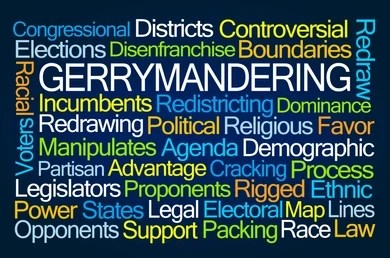
In a year already defined by political trench warfare, the battle over congressional maps has erupted into a full-scale arms race—one that threatens to redraw not just districts, but the very contours of American democracy.
The spark? A mid-decade redistricting blitz led by Republican-controlled states, beginning with Texas, where Governor Greg Abbott—under direct instruction from President Donald Trump—unveiled a new congressional map aimed at flipping five Democratic-held seats. The move shattered precedent and triggered a wave of retaliatory threats from Democratic governors across the country.
Texas wasn’t alone. Florida, Missouri, Ohio, and South Carolina quickly followed suit, leveraging their legislative majorities to redraw maps in ways that critics say are designed to entrench Republican power and silence opposition. “These aren’t just new lines,” said a spokesperson for Common Cause. “They’re barricades against accountability.”
In Florida, Governor Ron DeSantis is pushing a map that could add up to five new GOP seats. Missouri’s legislature is targeting swing districts with surgical precision. And in Ohio, lawmakers are openly defying court rulings that previously struck down gerrymandered maps.
Democrats, while vocal in their opposition, face structural constraints. In California, Governor Gavin Newsom is backing Proposition 50, a controversial measure that would override the state’s independent redistricting commission and allow a temporary Democratic-favored map—potentially flipping five seats. New York and Illinois are weighing similar moves. Governor JB Pritzker has hinted at redrawing Illinois’ already lopsided map, which currently favors Democrats 14–3. But experts say the state’s geography and existing saturation leave little room for further gains. “Democrats didn’t start this,” said one strategist. “But they’re now forced to play the game—or lose it.”
While gerrymandering is designed to lock in power, it may also provoke resistance. In swing districts where manipulation is most blatant, independent voters are expressing frustration. Some moderate Republicans have voiced discomfort with the aggressive tactics, calling them “shady” and “anti-democratic.” Minority communities—mainly Black and Latino voters—are being disproportionately affected by GOP redraws, sparking legal challenges and grassroots mobilization. “People don’t like being played,” said a voting rights attorney. “When the maps become weapons, voters start fighting back.”
As Republicans push mid-cycle redistricting in states like Texas, Missouri, and Florida, the backlash is no longer theoretical—it’s visible, vocal, and growing. In Missouri, GOP lawmakers carved up Kansas City across three districts to dilute Democratic votes. The move was so blatant that even Republican strategists warned it could backfire. “Voters who came out in 2024 for Trump may not show up in 2026,” one analyst noted, “especially if they feel the game is rigged.” The League of Women Voters issued a scathing rebuke of the GOP’s redistricting spree, calling it “uncharted territory” and accusing Republican leaders of exploiting racial division to silence voters. Their warning was clear: disenfranchised voters don’t disappear—they mobilize.
Even within the GOP, cracks are forming. A growing number of Republican lawmakers are publicly questioning Trump’s aggressive redistricting push, especially those in swing districts. “This poses a substantial risk to your career,” said California GOP strategist Rob Stutzman. “Redistricting isn’t ideological—it’s self-interest. And some Republicans know they’re being sacrificed.”
Voters aren’t just angry—they’re disoriented. When maps shift mid-decade, communities lose their political identity. Longtime constituents find themselves in unfamiliar districts, represented by politicians they didn’t vote for. That confusion breeds resentment—and resentment breeds turnout. Independent voters, especially, are wildcards. They’re less loyal to the party and more reactive to perceived manipulation. In gerrymandered districts where the lines scream “rigged,” independents may flip just to punish the party in power.
Grassroots groups are already capitalizing on the backlash. In Utah, a judge struck down a Republican-drawn map after voters passed a ballot measure banning partisan gerrymandering. In Texas, Democrats temporarily blocked a new map by fleeing the state to deny a quorum. These aren’t just stunts—they’re signals. The message is spreading: if the map is a weapon, voters will become insurgents.
Gerrymandering didn’t start with modern software or partisan super PACs. It began in 1812, when Massachusetts Governor Elbridge Gerry approved a redistricting plan that twisted one district into a shape resembling a salamander. A political cartoon dubbed it the “Gerry-mander,” and the name stuck. The goal then—as now—was simple: redraw the map to rig the outcome.
But even before Gerry’s infamous signature, colonial America had its own version of electoral manipulation. In the late 1700s, states like Virginia, North Carolina, and South Carolina were already drawing districts to favor specific candidates. The practice was inherited from England’s “rotten boroughs,” where tiny populations were used to manufacture parliamentary seats.
Throughout the 19th century, gerrymandering became a brutal tool. In 1852, Indiana Democrats won just 53% of the vote—but took 10 of 11 congressional seats thanks to a rigged map. The tactic was bipartisan, but the damage was universal: distorted representation, entrenched power, and voter disillusionment.
Americans didn’t just accept it. They fought back—sometimes through courts, sometimes through ballots, and sometimes through raw defiance. In the 1960s and ’70s, the Supreme Court stepped in with rulings like Baker v. Carr and Reynolds v. Sims, establishing the principle of “one person, one vote.” These cases forced states to redraw wildly unequal districts and gave voters a legal foothold. In the 1990s and 2000s, civil rights groups challenged racial gerrymanders, arguing that minority voters were being packed or cracked to dilute their power. Courts struck down several maps, especially in the South.
In the 2010s and 2020s, voters began passing ballot initiatives to create independent redistricting commissions. States like California, Michigan, Arizona, and Colorado led the way, removing map-drawing power from partisan legislatures. In Wisconsin, after a decade-long legal battle, the state Supreme Court ruled in 2024 that Wisconsin’s maps violated the constitution. Governor Tony Evers signed new maps into law, ending one of the most egregious gerrymanders in the country.
Gerrymandering is as old as the republic—but so is resistance. Every time politicians twisted the map, Americans found ways to untangle it. Through lawsuits, legislation, and grassroots mobilization, voters have repeatedly forced the system to reckon with its own distortions.
The Republican Party’s mid-decade redistricting blitz—spearheaded by President Trump and executed by governors like Greg Abbott and Ron DeSantis—isn’t just a power grab. It’s a stress test for democracy. But Americans aren’t without tools. Here’s how to fight back.
The most direct path to neutralizing GOP gerrymandering is a federal law banning partisan and racial map manipulation. As American Progress outlines, this would force all states—red and blue—to play by the same rules. Until then, states with independent commissions should adopt a mutual disarmament treaty, temporarily setting aside their commissions to level the playing field until Congress acts.
California’s Proposition 50 is the blueprint. Governor Gavin Newsom called a special election to temporarily override the state’s independent commission and redraw the map to favor Democrats—not to entrench power, but to counterbalance GOP aggression. Other states like New York and Illinois are exploring similar moves. These aren’t ideal—but they’re strategic countermeasures in a rigged war.
Courts remain a powerful weapon. In states like Wisconsin and Utah, lawsuits have overturned gerrymandered maps. Civil rights groups can challenge racial packing and cracking under the Voting Rights Act. Legal pressure also forces transparency—exposing the partisan intent behind redistricting.
Organizations like Swing Left are mobilizing canvassers and phone bankers to support anti-gerrymandering ballot measures. Face-to-face conversations and voter education campaigns can have a significant impact on local elections and contribute to the passage of reforms. Every door knocked, every call made, is a strike against manipulation.
Gerrymandering thrives in the shadows. Use social media, op-eds, and community forums to spotlight how GOP maps dilute votes, fracture communities, and entrench minority rule. Shame is a strategic tool—mainly when aimed at politicians who claim to defend democracy while rigging the rules.
Winner-take-all districts are the root of the problem. Proportional systems—where seats match vote share—make gerrymandering obsolete. Reformers are pushing ranked-choice voting and multi-member districts as long-term solutions.
This isn’t just a policy fight—it’s a narrative war. Every manipulated map is a story of stolen representation. But every act of resistance is a reminder: the lines may be rigged, but the people still draw the future.
And let’s be clear: Trump and the GOP started this mess. They broke precedent, weaponized redistricting, and launched a coordinated assault on fair representation. But the American people are not passive observers. They are the rightful architects of democracy. Their vote matters—not the GOP’s manipulation, not Trump’s directives, not the lines drawn in secret behind closed doors.
The map war is real. But so is the resistance.

