


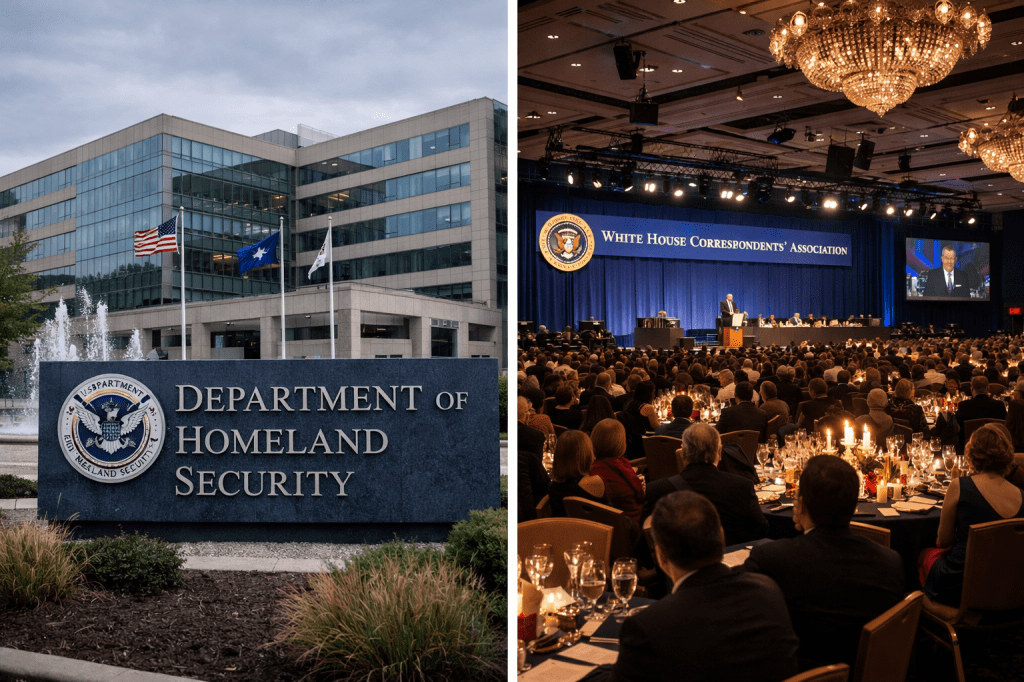
WASHINGTON — A rapid series of political developments — including a ballroom funding freeze, a Department of Homeland Security (DHS) funding freeze, declining poll numbers for Donald Trump and Republican candidates. Trump’s unexpected appearance at the White House Correspondents’ Dinner is drawing heightened scrutiny from analysts who say the timing of these events is too closely aligned to dismiss. While each development can stand on its own, the way they unfolded in near‑sequence has led many observers to wonder whether these moments are connected in ways not yet fully understood. The ballroom and DHS funding freezes, both high‑profile decisions, have become flashpoints in ongoing federal disputes. Analysts note that such freezes often emerge during budget standoffs, but the proximity of these actions to other political shifts has intensified debate. Several observers say the freezes created a climate of uncertainty that may have shaped the environment leading into the events that followed. This backdrop now feels more significant in hindsight.
Trump’s decision to attend the Correspondents’ Dinner — an event he had consistently avoided during his previous term — added another unexpected turn. The dinner, packed with journalists, cameras, and live national coverage, is widely regarded as one of Washington’s most visible platforms. It was during this event that an attempted attack on Trump occurred, immediately dominating national headlines. The alleged attacker reportedly had past political donations linked to Democratic figures, including Vice President Kamala Harris. While investigators have not released full findings, the detail quickly became a focal point in political commentary and online debate, raising questions about how such a moment could unfold at such a high‑profile gathering — and why it happened precisely when it did.
Trump declared the incident the work of a “lone gunman” within hours, well before official investigative updates were available. Analysts note that such early declarations are uncommon in high‑profile security incidents, where public statements typically follow formal briefings and the provision of verified information. The speed of the statement, combined with the lack of confirmed details, has drawn attention from observers who say the response felt unusually swift. Questions have also emerged about security protocols at the event. Reports of relaxed procedures, unusual access points, and other irregularities have led some to wonder whether the environment was more vulnerable than expected. Officials have not confirmed whether any procedural failures occurred. Still, the concerns have added to the growing list of unresolved issues — issues that some analysts say take on new weight when viewed alongside the earlier funding freezes and the broader political climate.
In the days following the incident, the administration escalated its criticism of Democrats and left‑leaning groups, framing the attempted attack as evidence of rising extremism. The shift in messaging coincided with recent polling showing challenges for several Republican candidates, prompting analysts to examine whether the incident is influencing political strategy. Political observers say the timing of the rhetoric — combined with the earlier funding freezes and the high‑visibility nature of the Correspondents’ Dinner — has fueled broader speculation about whether the sequence of events may serve political purposes. Some commentators argue that the alignment of these developments creates a narrative that benefits the administration at a moment of political vulnerability, though no direct connections have been established. Still, the overlap in timing has kept questions alive, and the atmosphere surrounding the events has grown increasingly uneasy.
Supporters of this view emphasize that they are not making accusations but urging the public to consider the broader context. They point to the ballroom freeze and DHS funding freeze as key components of the environment leading up to the incident, arguing that these decisions heightened tensions and shaped public perception in ways that made the subsequent events more politically consequential. As investigators continue to examine the attempted attack, analysts say the convergence of these events — the funding freezes, the declining poll numbers, the unexpected appearance at the Correspondents’ Dinner, and the rapid political messaging that followed — has intensified debate about the role of timing, narrative, and political incentives in shaping public understanding of major incidents.
For now, observers say the central question remains: when so many developments align so closely, is the public witnessing coincidence — or a political strategy unfolding in real time? And with several details still unclear, the sense that these events may be connected continues to cast a long, unsettled shadow.
References
https://www.nytimes.com/2023/09/29/us/politics/dhs-funding-shutdown.html
https://www.washingtonpost.com/politics/2023/09/28/government-shutdown-dhs-funding/
https://www.cnn.com/2023/09/27/politics/dhs-funding-shutdown-impact
https://www.govexec.com/management/2023/10/federal-building-projects-halted-budget-standoff/390000/
https://www.reuters.com/world/us/us-federal-building-projects-face-delays-due-budget-fights-2023-10-12/
https://www.politico.com/news/2023/10/01/federal-facility-funding-freeze-00119523

