

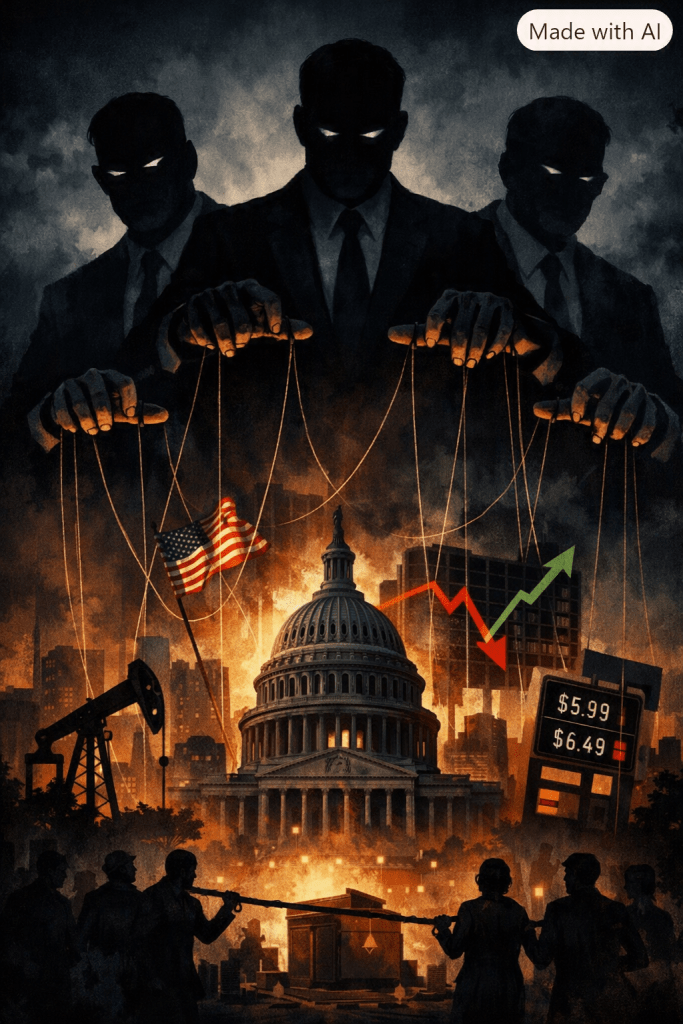
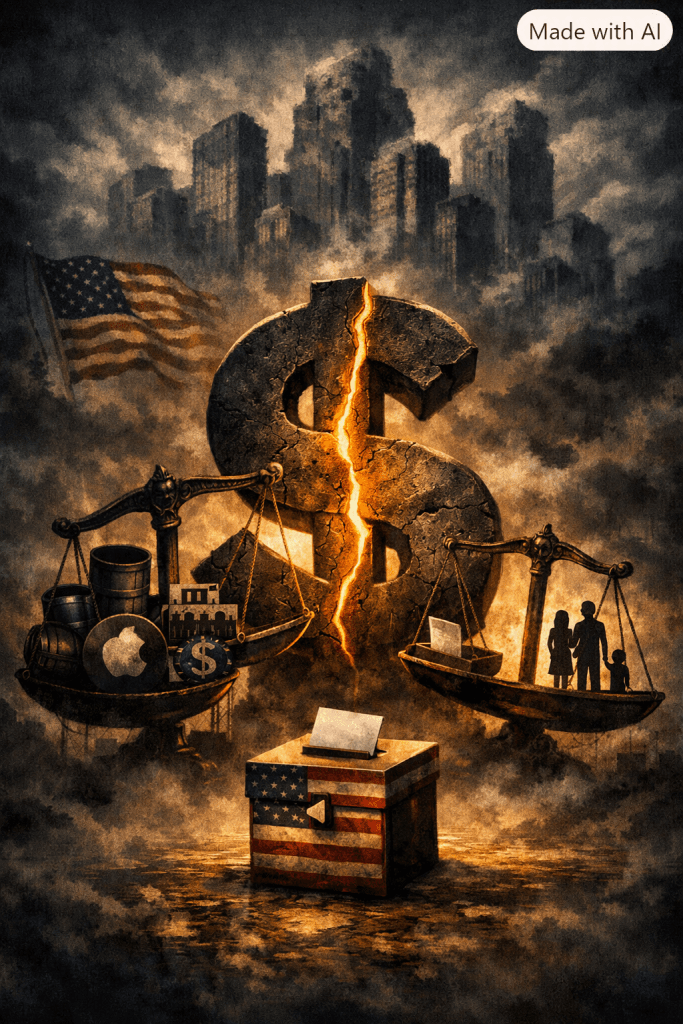
America’s affordability crisis didn’t appear overnight. As Robert Reich has repeatedly argued, its roots lie in the growing concentration of economic and political power among corporations so large that workers and consumers have no meaningful alternatives. When corporate power expands and worker power shrinks, prices rise, wages stagnate, and essential goods become harder to afford. This is not a natural economic cycle — it is the predictable result of decades of policy choices that weakened antitrust enforcement, undermined labor protections, and allowed financial interests to dominate the basic necessities of life. For millions of Americans, this hasn’t just been an economic shift — it has been a slow erosion of stability, dignity, and hope. The danger here is not abstract: it is the steady hollowing‑out of the economic foundation ordinary people depend on, threatening the very idea of a fair and livable society.
Reich explains that corporate profits now account for the largest share of the economy in 75 years, while worker pay has slumped — a direct consequence of corporations monopolizing markets and reducing workers’ bargaining power. When a handful of companies dominate an industry, they can raise prices without fear of competition and suppress wages because workers have nowhere else to go. This shows up in daily life through higher grocery prices, lower wages, and rising costs for essentials like healthcare and broadband. Families feel this every single day — in the checkout line, at the pharmacy counter, in rent payments that rise faster than paychecks. Reich notes that anti‑monopoly laws have not been enforced since the 1980s, allowing corporations to grow larger and dominate markets. At the same time, labor laws have been weakened, union membership has collapsed, and corporate lobbying has pushed states to adopt laws that make organizing harder. The result is an economy where workers face stagnant wages while corporations siphon off a larger share of revenue into profits, leaving ordinary people struggling to keep up. The danger is cumulative: every year of inaction deepens the imbalance, making recovery not only harder — but more urgent.
Affordability dominates the national conversation because the structural forces Reich identifies have been compounding for decades. Median wages have stagnated while productivity has risen. Union membership has collapsed to just 6.4% of private‑sector workers, leaving most employees without collective bargaining power. Meanwhile, corporate giants like Amazon and Walmart have replaced the high‑wage, unionized jobs that once sustained the middle class with low‑pay, high‑stress warehouse and delivery work. This hasn’t just reshaped the labor market — it has reshaped people’s lives. Parents working two jobs still fall behind. Young adults delay starting families. Seniors stretch fixed incomes until they snap. Reich argues that this decades‑long shift has produced near‑record inequality, with the richest 0.1% holding almost as much wealth as the bottom 90% combined. When wealth concentrates at the top, political power follows, allowing corporations to shape rules that further erode affordability for ordinary families. This is why affordability isn’t just an economic issue — it’s the defining political pressure of 2026, and a source of daily hardship for millions. The danger is systemic: a democracy cannot remain stable when economic power is this concentrated, and people cannot thrive when the rules are written against them.
Reich’s analysis fits squarely within the concept of the K‑shaped economy, in which the wealthy rise while everyone else falls behind. The top branch of the “K” includes corporations enjoying record profits, shareholders benefiting from soaring stock prices, and executives whose compensation has skyrocketed. The bottom branch includes workers whose bargaining power has eroded, families facing rising costs of groceries and housing, and communities where wages no longer keep pace with the cost of living. For people on the lower branch, this divergence isn’t abstract — it’s felt in skipped meals, overdue bills, postponed medical care, and deferred dreams. Reich shows that this divergence is not a temporary distortion — it is the predictable outcome of weakened antitrust enforcement, diminished labor power, and the rise of corporate giants that dominate markets. When workers have fewer alternatives and corporations face less competition, affordability collapses — and people suffer. The danger is widening: the branches of the “K” are pulling further apart, threatening long‑term social cohesion and the promise of upward mobility itself.
The K‑shaped economy did not suddenly appear in 2026. Its structure was already forming during Donald Trump’s presidency, and Robert Reich documented how policy choices during those years accelerated the divergence between the top and bottom branches of the “K.” This is an honest assessment, not a political attack, because it is based on publicly available economic data, documented outcomes of the 2017 Tax Cuts and Jobs Act, Reich’s published analysis, and independent findings from multiple economic institutions. Nothing here is fabricated, exaggerated, or speculative. And the consequences of those choices were not theoretical — they were lived by millions of Americans who saw costs rise faster than wages, who watched corporate profits soar while their own financial security eroded. The danger is historical: once inequality reaches this level, it rarely reverses without deliberate, collective action.
Trump’s 2017 Tax Cuts and Jobs Act — the “big beautiful bill” — played a major role in shaping the K‑shaped economy. Reich explains that the bill cut the corporate tax rate from 35% to 21%, delivered the largest benefits to corporations and high‑income households, encouraged stock buybacks rather than wage increases, accelerated corporate consolidation, and increased the deficit, thereby creating pressure to cut social programs. These outcomes strengthened the top branch of the K‑shape while leaving the bottom branch behind. For everyday Americans, this meant promises of wage growth that never arrived, rising costs that never eased, and a widening gap between what families earn and what life costs. The danger is structural: policies that enrich the top while weakening the bottom create long‑term instability that threatens both economic fairness and national resilience.
The TCJA was aggressively promoted by GOP leadership as a historic middle‑class tax cut, a self‑funding economic engine, and a wage‑boosting corporate incentive. However, independent economic analyses from the Congressional Research Service, Brookings, the American Economic Association, and the Congressional Budget Office show that many of the GOP’s public claims did not match the actual outcomes. The GOP claimed the tax cuts would pay for themselves, but the Congressional Research Service found the TCJA did not pay for itself and instead increased federal debt. GOP leaders said corporations would use the tax cuts to raise wages, but Brookings found median wage growth slowed and corporations used the tax windfall for record stock buybacks. GOP messaging emphasized middle‑class relief, but the American Economic Association found the TCJA disproportionately increased incomes for the most affluent. GOP leaders promised explosive economic growth, but the CRS reported GDP growth projections that fall far short of those promises. GOP leaders claimed small businesses would thrive, but the CRS found the pass‑through deduction produced uneven and limited benefits. GOP leaders said the bill would simplify taxes, but the CRS documented that the TCJA introduced complex new rules, making the system more complicated. For millions of Americans, these broken promises translated into deeper financial strain, fewer opportunities, and a growing sense that the system was not built for them. The danger is political: when leaders make promises that do not match reality, public trust erodes — and the legitimacy of institutions weakens.
Reich’s solutions focus on rebalancing power in the economy so affordability becomes a structural reality rather than a political slogan. He argues for restoring strong antitrust enforcement, citing the Federal Trade Commission’s challenge to the Kroger–Albertsons merger as an example of how antitrust can protect both consumers and workers. He emphasizes rebuilding worker bargaining power by strengthening labor laws and making it easier to form unions. He calls for reducing the financialization of essentials like housing, healthcare, and education, arguing that when necessities become investment vehicles, affordability collapses. And he stresses the need to reinforce democratic rule‑setting so corporate lobbying cannot tilt the rules of the economy toward concentrated wealth. Reich’s core message is that affordability is not a personal failure — it is a structural problem created by policy choices. Fixing it requires confronting concentrated power head‑on, and doing so is not just an economic necessity — it is a moral one, because real people are hurting. The danger is moral: ignoring suffering becomes a choice, not an accident — and choosing differently is how societies heal. As these long‑term structural forces continue to shape the economic landscape, their influence becomes even more visible in the short‑term political and corporate maneuvers ahead of the 2026 election.
Transition: Connecting Long‑Term Structural Danger to Election‑Year Manipulation
The structural forces described above do not exist in isolation. As the 2026 election approaches, these long‑term economic imbalances are intersecting with short‑term political strategies, creating conditions in which corporate pricing decisions, shifts in foreign energy production, deregulation policies, and election‑year messaging may influence voter perceptions. The danger is not only economic — it is political, and it is unfolding right now.
Summary: As the 2026 U.S. election approaches, economic trends have become a battleground for political leaders and corporate powerhouses. Inflation has reached its lowest level in four years, fostering an illusion of stability. Yet beneath the surface, critical questions remain: Are political and corporate forces strategically shaping this narrative to serve their own interests? Deregulation, corporate tax cuts, and foreign energy decisions may be shifting market conditions in ways that benefit Republican messaging. Meanwhile, corporate lobbying and donations continue to shape political strategies, fueling concerns over manipulation. Voters cannot afford complacency. Scrutiny is essential to ensure that economic realities are not distorted for political gain. As these long‑term structural forces continue to shape the economic landscape, their influence becomes even more visible in the short‑term political and corporate maneuvers ahead of the 2026 election.
Full Article:
With the 2026 U.S. election approaching, economic trends have become more than just numbers on a spreadsheet—they have become instruments of political influence. Inflation has reached its lowest level in four years, according to reports from multiple sources, including the Bureau of Labor Statistics. While this signals stability on the surface, deeper scrutiny reveals potential coordination between political and corporate forces seeking to craft a favorable election-year narrative.
Historically, administrations have leveraged positive economic indicators to reinforce their political standing, while industries have adjusted pricing strategies to align with market expectations. Energy companies, financial institutions, and major retailers are among the entities well positioned to benefit from these shifts in policy and messaging.
Economic influence and deregulation have long played a crucial role in corporate strategy. The energy sector, in particular, has seen notable gains under recent policy changes. Companies like ExxonMobil, Chevron, and ConocoPhillips have reaped rewards from deregulation, tax incentives, and expanded drilling opportunities. Meanwhile, financial giants such as JPMorgan Chase and Goldman Sachs have maintained steady investment trends despite broader market concerns, signaling their ability to navigate and perhaps exploit changing regulatory environments.
Deregulation policies introduced by the Trump administration significantly altered corporate strategies across various industries. Reduced oversight on lending practices enabled financial institutions like JPMorgan Chase and Goldman Sachs to expand profits, while loosened restrictions on drilling and pipeline expansion accelerated the growth of ExxonMobil and Chevron. Technology firms, such as Google and Meta, benefited from relaxed scrutiny of data privacy regulations, while defense contractors like Lockheed Martin and Boeing capitalized on surging military spending.
The 2017 Tax Cuts and Jobs Act delivered a seismic shift in corporate finance, slashing tax rates and funneling billions into stock buybacks and shareholder returns. Corporations such as Walmart, AT&T, Meta, Home Depot, Intel, and Amazon saw substantial gains, while financial institutions, energy firms, and defense contractors experienced enormous tax savings. This restructuring of corporate taxation reshaped business strategies, reinforcing industry leaders’ influence over economic policy.
Some analysts argue that corporations may be strategically managing inflation or adjusting pricing models to cultivate a favorable economic climate ahead of the election. Business decisions are rarely isolated from political realities—regulatory changes, tax policies, and consumer sentiment all shape corporate strategies. If major players in energy, retail, and finance are stabilizing prices or delaying increases, it could suggest an orchestrated effort to sway voter perceptions.
A stable economic climate has direct political consequences. If voters interpret inflation control and price stability as evidence of competent leadership, Republicans in Congress and the Senate stand to gain. Election-year economic messaging is a powerful tool for shaping voter sentiment, and if corporate pricing strategies align with administration policies, it could validate conservative fiscal approaches, ultimately influencing voter confidence and legislative outcomes.
Corporate donations and lobbying efforts remain at the heart of political maneuvering. Industries such as finance, oil, technology, and cryptocurrency have poured millions into Republican campaigns, solidifying alliances that influence policy decisions. Reports indicate that business donors contributed over $425 million in the 2024 election cycle, with nearly two-thirds of industry contributions bolstering GOP candidates. JPMorgan Chase, ExxonMobil, Amazon, Coinbase, and CoreCivic have significantly increased their financial support, raising concerns about the extent to which corporate interests influence legislative priorities.
Foreign influence in economic strategy further complicates this equation. Some analysts suggest that corporations, alongside certain foreign governments, have strategically manipulated energy prices to bolster Trump’s administration. Reports indicate that OPEC+ ramped up oil production during Trump’s tenure, reinforcing his economic messaging on energy affordability. Conversely, under President Biden, oil-producing nations, including Saudi Arabia, have reportedly reduced output, driving gas prices higher, prompting speculation that these production cuts were politically motivated.
Such foreign economic influence raises alarming concerns over election interference. If oil-producing nations deliberately manipulate energy prices to shape voter sentiment, it could constitute a covert form of election meddling. While traditional interference often involves cyberattacks and disinformation campaigns, economic maneuvers—such as controlling global oil supplies—carry immense power in shaping public perception and electoral outcomes. The timing of production shifts may align with political cycles, warranting increased scrutiny into whether these actions are engineered to benefit specific candidates or parties.
Corporate strategies, economic shifts, and foreign energy decisions that reinforce conservative messaging could have a profound impact on Republicans in Congress and the Senate. Lower gas prices, perceived economic stability, and deregulation efforts tend to strengthen conservative fiscal arguments, making them more appealing to voters. Additionally, corporate lobbying and financial contributions provide Republicans with enhanced campaign resources, fortifying their narratives on economic growth, tax reductions, and business-friendly policies. The perceived influence of foreign actors manipulating oil prices may also fuel debates over national security and economic sovereignty, further shaping voter confidence.
While direct coordination between corporations, foreign entities, and the administration remains difficult to prove, patterns in financial disclosures, lobbying efforts, and industry trends strongly suggest that businesses and foreign governments may be quietly orchestrating economic conditions to align with election-year strategies. These subtle yet powerful maneuvers risk distorting public perception, creating an artificial sense of stability or crisis that serves politicians’ interests rather than the long-term well-being of voters.
Economic shifts—whether driven by corporate pricing strategies, inflation adjustments, or foreign-controlled energy markets—may not be the result of natural financial fluctuations. Instead, they could be calculated efforts designed to manipulate voter confidence, influence policy debates, and reinforce specific electoral narratives.
As the election cycle accelerates, voters must remain vigilant. Sudden market shifts must be questioned, short-term relief must not be taken at face value, and leadership must be evaluated with skepticism. Financial conditions can be manipulated—whether through corporate influence, foreign energy production cuts, or strategic market timing—to create illusions of prosperity or instability, shaping public perception rather than reflecting genuine economic health.
Failure to recognize these warning signs could enable economic manipulation, ultimately undermining the integrity of democratic decision-making. Voters must actively seek out reliable data, critically analyze financial trends, and demand transparency from corporations and foreign entities whose priorities may not align with the public interest. Scrutiny and awareness are the only defenses against the distortion of economic narratives for political gain.
Inspiration: How We Can Change This Together in the Upcoming Midterms
The affordability crisis is not inevitable. It is not permanent. It is not beyond repair. It is the result of choices — and choices can be changed.
The upcoming midterms are not just another election cycle. They are a moment when millions of people can decide what direction this country takes. Not by choosing a party or a personality — but by choosing policies, priorities, and leaders who understand the stakes.
Across the country, people are waking up to the reality that affordability is not a personal failure — it is a structural failure. And structural failures can be corrected when people participate, speak up, organize, and vote in ways that align with their values and lived experiences.
The midterms give Americans the chance to:
- Support candidates who prioritize fair competition, worker power, and affordability.
- Elect leaders who understand the danger of concentrated economic power.
- Choose representatives who will strengthen antitrust enforcement, protect workers, and defend the basic building blocks of a stable life.
- Send a message that policies must serve people, not just corporations.
This is not about partisanship — it is about people reclaiming agency in a system that has drifted too far from their needs.
Every vote cast in the midterms is a statement: We see what’s happening. We feel the danger. And we refuse to accept an economy that leaves millions behind.
Change does not come from hope alone — it comes from action. And action is exactly what the midterms allow.
If Americans show up, speak out, and vote with clarity and conviction, the affordability crisis can be confronted head‑on. The K‑shaped economy can be reshaped. The imbalance of power can be corrected. And the future can be more stable, more fair, and more humane than the present.
The danger is real — but so is the opportunity. And the midterms are where that opportunity begins.
References (All Blue Clickable)
What Happened to Organized Labor? — Inequality Media with Robert Reich https://inequalitymedia.org/watch/what-happened-to-organized-labor
How Corporations Crush the Working Class — Inequality Media with Robert Reich https://inequalitymedia.org/watch/how-corporations-crush-the-working-class
Robert Reich: Why Giant Mergers Harm Workers — Eurasia Review https://www.eurasiareview.com/03092024-robert-reich-why-giant-mergers-harm-workers-oped/
Congressional Budget Office — Analysis of the 2017 Tax Cuts and Jobs Act https://www.cbo.gov/publication/53415
Congressional Research Service — Economic Effects of the TCJA https://crsreports.congress.gov/product/pdf/R/R45736
American Economic Association — TCJA Distributional and Growth Effects https://www.aeaweb.org/articles?id=10.1257/jep.33.4.163
Brookings Institution — Market Concentration and Competition https://www.brookings.edu/articles/market-concentration-and-competition-in-the-u-s-economy/
Brookings Institution — Corporate Investment After TCJA https://www.brookings.edu/articles/the-impact-of-the-tax-cuts-and-jobs-act-on-business-investment/
Harvard Business Review — Stock Buybacks After the TCJA https://hbr.org/2019/01/the-high-price-of-stock-buybacks
Center on Budget and Policy Priorities — Distributional Effects of the TCJA https://www.cbpp.org/research/federal-tax/the-tax-cuts-and-jobs-act-continues-to-benefit-the-rich
Fair‑Use and Public Commentary Disclaimer
This article discusses publicly available political and economic commentary, including statements made by Robert Reich and analyses published by independent institutions, government agencies, and research organizations. All referenced material is used under fair use for purposes of commentary, analysis, education, and public discussion. No copyrighted articles, transcripts, or proprietary content are reproduced in full. All summaries, interpretations, and citations refer to publicly accessible sources. Readers are encouraged to verify information through trusted, authoritative outlets and to consult original documents for full context.