


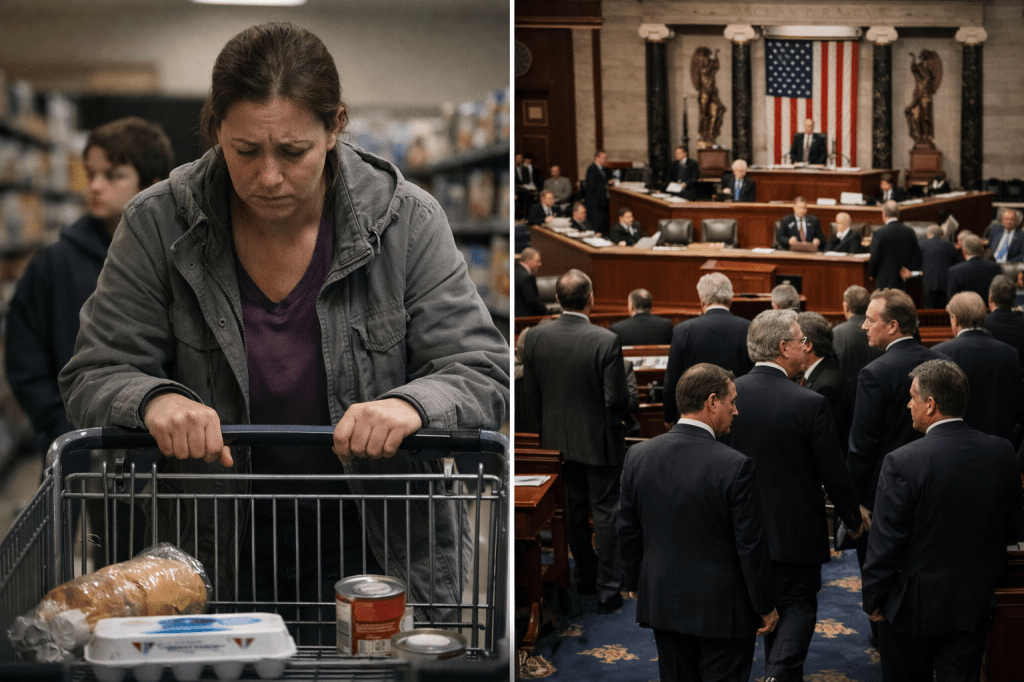
WASHINGTON — A nationwide reduction in food stamp benefits is rippling through all 50 states, creating economic strain for millions of low‑income households and raising the possibility of a political backlash in the 2026 elections. For many families, the cuts are not abstract policy shifts — they are daily realities that determine what goes on the dinner table, how bills get paid, and whether parents can keep their households stable. Analysts caution that no election outcome can be predicted, but the scale of the cuts is creating conditions that historically have shifted voter sentiment. Beneath the political implications lies something far more urgent: a growing sense of danger for families suddenly unsure how they will feed themselves.
The Supplemental Nutrition Assistance Program (SNAP), a federal safety‑net program serving more than 40 million Americans, has seen participation fall in every state following recent federal policy changes. These include stricter work requirements, tightened eligibility rules, and administrative removals that states were required to implement. Anti‑hunger researchers say the reductions are unprecedented in their nationwide reach, and the human impact is already visible in communities across the country. For many, the danger is immediate — hunger is not a distant threat but a present one.
Arizona, Georgia, Florida, Texas, and California are among the states experiencing the largest losses. Arizona, in particular, has seen one of the steepest percentage declines, with significant drops among children, working families, and rural households. But the impact is not limited to a handful of regions; every state is reporting reductions, meaning the political effects extend nationwide. For many families, the loss of benefits has meant stretching meals, skipping groceries, or relying on food banks that are already overwhelmed. The danger here is not theoretical — it is the erosion of the most basic form of security: access to food.
Economists and political scientists note that SNAP cuts tend to hit groups central to national elections, including independents, seniors, single parents, Latino and Black households, and rural low‑income voters. These groups are heavily represented in battleground states such as Arizona, Georgia, North Carolina, Wisconsin, Pennsylvania, and Michigan. When these communities experience economic strain, it often translates into heightened political engagement — not out of ideology, but out of necessity. The danger is that millions of people who were already living on the edge are now being pushed past it.
Historically, large‑scale economic disruptions — including benefit cuts, healthcare changes, or sudden increases in cost of living — have contributed to national political waves. Analysts point to 2010, 2018, and 2022 as examples where economic anxiety and policy backlash increased turnout and shifted voter sentiment. While experts emphasize that no outcome is guaranteed, the current environment mirrors several of those earlier cycles. For families living through these cuts, the political implications are secondary to the immediate question of how to feed their children. The danger is not just economic — it is emotional, psychological, and deeply personal.
Political strategists say the key factor is perception: voters tend to hold the governing party responsible for economic hardship, regardless of the policy’s complexity. With SNAP reductions affecting households in every state, the issue has the potential to influence voter attitudes nationwide. As the 2026 election cycle intensifies, both parties are watching closely. The widespread loss of food assistance has become a central point of debate in state legislatures, congressional districts, and gubernatorial races, particularly in states where many families rely on SNAP to offset rising food costs. The danger for policymakers is that the consequences of these cuts are not contained — they spill into classrooms, workplaces, hospitals, and neighborhoods.
Whether this translates into a national political shift remains uncertain. But the scale of the cuts — and the breadth of the affected population — has created conditions that could shape voter sentiment in ways not seen in more than a decade. For many Americans, the conversation is not about politics at all — it’s about survival, dignity, and the emotional toll of not knowing whether next week’s groceries will be affordable. The danger is that hunger, once introduced into a household, rarely stays contained; it affects health, stability, and long‑term opportunity.
The reductions in food stamp benefits stem from provisions included in the 2025 federal budget and policy package, which was passed by congressional Republicans and signed into law by President Donald Trump. The legislation included expanded work requirements, tighter eligibility rules, restrictions affecting certain immigrant households, and administrative directives requiring states to remove non‑compliant recipients. Democrats in both the House and Senate opposed the SNAP‑related provisions, arguing they would increase hunger, strain food banks, and disproportionately harm children, seniors, and low‑income workers. Republicans defended the changes as part of a broader effort to reduce federal spending and encourage workforce participation. Because SNAP is a federal program, the changes apply nationwide. The danger, critics argue, is that the policy’s broad reach means millions of vulnerable people are affected at once.
The bill moved through Congress beginning in January 2025, when House Republican leadership drafted the legislation. It advanced through House committees in February, passed the House in March with only Republican votes, moved through Senate committees in April, passed the Senate in May along party lines, was finalized in conference in June, passed both chambers again in July, and was signed into law by President Trump shortly thereafter. States implemented the new rules through late 2025 and 2026, during which millions lost benefits. For many families, the implementation period was confusing and emotionally draining, as letters arrived announcing benefit reductions or terminations with little explanation. The danger was not just the loss of benefits — it was the suddenness, the uncertainty, and the lack of support.
Many analysts trace the roots of the current crisis back to the major tax cuts passed for corporations, millionaires, and billionaires. Those cuts significantly reduced federal revenue, and the resulting deficit pressure later became the justification for slashing safety‑net programs instead of revisiting the earlier tax breaks. In this view, the blame lies squarely with Congress and the wealthy donor class whose interests were prioritized, leaving low‑income families to bear the consequences.
The nationwide reduction in food stamps is reshaping daily life for millions, cutting into household budgets, increasing food insecurity, and forcing families to make difficult choices. Families are buying cheaper, less nutritious food, skipping meals, and relying more heavily on food pantries. Working families — many of whom already live paycheck‑to‑paycheck — are hit hardest, while seniors and disabled adults face impossible choices between food, medication, and utilities. These are not abstract hardships; they are lived experiences that carry emotional weight and daily stress. The danger is cumulative — hunger compounds other vulnerabilities.
Rural communities, where wages are lower and food prices higher, are especially vulnerable. Children, who make up nearly half of all SNAP recipients, are losing access to reliable nutrition, with teachers and pediatricians reporting rising hunger‑related issues. Food banks are overwhelmed, local economies are losing spending power, and emotional stress is rising across affected households. Many families describe feeling forgotten, unseen, or blamed for circumstances beyond their control. The danger is that these pressures can destabilize entire communities.
The demographic groups most harmed include children, low‑income working families, seniors on fixed incomes, people with disabilities, Latino and Black households, rural white working‑class families, single parents, and veterans. These groups overlap heavily with key voting blocs in battleground states. For many, the loss of SNAP is not just a financial blow — it is a psychological one, eroding their sense of stability and security. The danger is that once that sense of stability is lost, it is difficult to rebuild.
Analysts note that these demographic shifts may influence swing‑state turnout by increasing participation among economically stressed voters, making independent voters more volatile, shifting rural turnout in unpredictable ways, mobilizing Latino and Black voters, increasing competitiveness in suburban districts, and driving civic engagement through overwhelmed community organizations. With SNAP reductions affecting millions across all 50 states, the political consequences may be far‑reaching, even if the ultimate electoral impact remains uncertain. What is certain is that millions of Americans are navigating fear, frustration, and uncertainty — and those emotions often find their way into the voting booth. The danger is not just in the present moment, but in the long‑term ripple effects these cuts may have on families, communities, and the nation as a whole.
Even in the middle of hardship, there is room for hope — not the vague kind, but the kind rooted in action, community, and the resilience Americans have shown in every difficult chapter of the nation’s history.
Across the country, people are already stepping up. Food banks, churches, neighborhood groups, and volunteers are filling gaps they never expected to fill. Teachers are quietly buying snacks for hungry students. Local farmers are donating produce. Communities that have been overlooked are finding strength in each other. These acts don’t erase the danger — but they prove that people are not powerless.
Policy can change, too. SNAP has been expanded, strengthened, and rebuilt before. Every major improvement in the program’s history came because ordinary people raised their voices, shared their stories, and refused to accept hunger as normal. Change has never come from Washington alone — it has always come from the ground up.
The path forward is not mysterious. It begins with awareness, continues with compassion, and becomes real through collective pressure. When families speak up, when communities organize, when voters demand better, lawmakers — regardless of party — eventually respond. History shows that when enough people insist on dignity, dignity wins.
The danger is real. But so is the possibility of repair.
And the truth is simple: a country that can feed millions can also choose to feed its own people.
The mess is big — but it is not permanent.
And the people living through it are stronger than the crisis they face.
Sources
Center on Budget and Policy Priorities — SNAP Participation Declines
https://www.cbpp.org
USDA Food and Nutrition Service — SNAP Data Tables
https://www.fns.usda.gov
Arizona Department of Economic Security — SNAP Enrollment Reports
https://des.az.gov
Georgia Division of Family & Children Services — SNAP Statistics
https://dfcs.georgia.gov
Feeding America — Food Insecurity Trends
https://www.feedingamerica.org
Pew Research Center — Voter Attitudes and Economic Policy
https://www.pewresearch.org

