


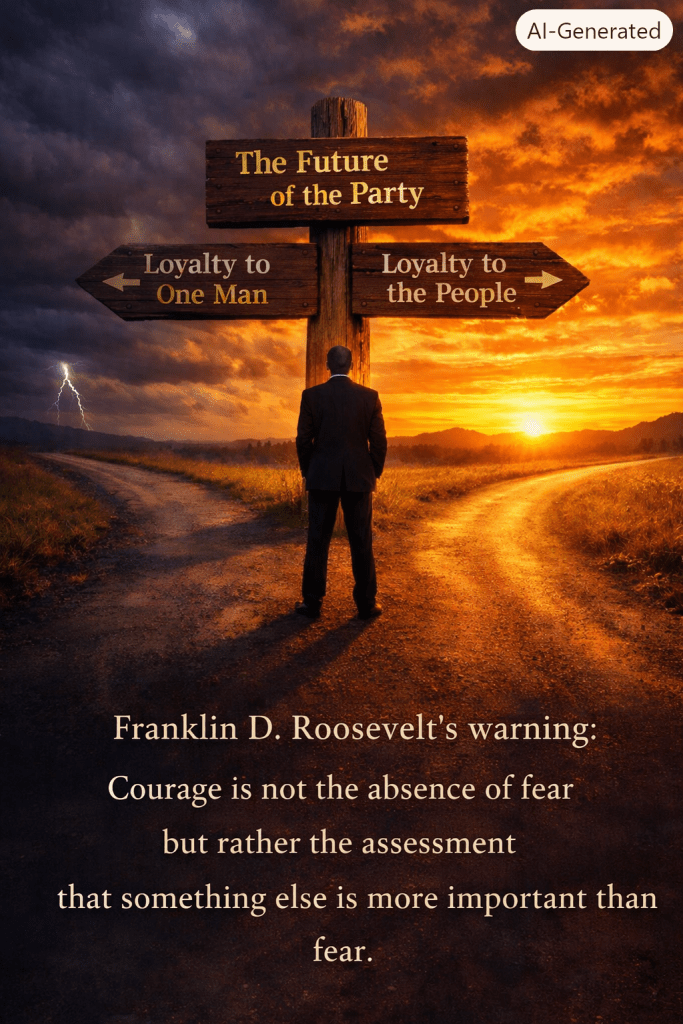
Over the past several years, the Republican Party has undergone a dramatic transformation—one that millions of Americans have watched with growing concern, disappointment, and even sadness. What was once a broad conservative coalition grounded in principles and public service now appears increasingly shaped around one man: Donald Trump. For many voters, this shift feels personal. It feels like a betrayal of the trust they placed in leaders who promised to represent them. The question many are now asking is simple but heavy: Has the Republican Party abandoned the people who elected them in favor of serving Trump’s political interests?
For decades, the Republican Party has championed limited government, fiscal discipline, respect for the Constitution, and a commitment to the everyday American. Today, those pillars feel overshadowed by a single priority: demonstrating unwavering loyalty to Donald Trump. Political analysts, journalists, and even former Republican officials have repeatedly documented the same pattern: GOP lawmakers echo Trump’s talking points even when they contradict established facts; those who dare to criticize him face immediate political punishment; and legislative priorities increasingly revolve around Trump’s grievances rather than the nation’s needs. For many Americans, watching this unfold has been painful. The party that once prided itself on independence now feels defined by submission — and that shift carries real danger. When a political party becomes centered around one individual rather than a set of principles, it risks losing its ability to govern responsibly, think independently, and serve the public good.
Millions of traditional conservatives, moderates, and independents feel ignored and pushed aside. These are the voters who once formed the backbone of the Republican Party—small‑town families, working‑class Americans, military households, business owners. They are people who believed in the party’s promises and values. Now, they watch their elected officials prioritize Trump’s demands over their own. Americans consistently rank healthcare, wages, education, infrastructure, and retirement security as top concerns. Yet Republican lawmakers spend far more time defending Trump’s legal battles, amplifying his narratives, and fighting symbolic political wars than addressing the issues that affect everyday life. Reports show GOP leaders routinely shape their strategies around Trump’s wishes—even when those wishes conflict with the interests of their districts. This leaves many voters feeling unheard, unrepresented, and forgotten. Many lifelong Republicans now say the party they supported for decades no longer exists. What was once a policy-rooted movement has become one rooted in personality — and that shift is dangerous because it erodes the foundation of representative democracy.
One of the most troubling developments is the extent to which Republican lawmakers appear willing to bend over backward to please Donald Trump. Their actions increasingly reflect a hunger for power rather than a commitment to public service. Trump’s grip on the Republican base has created a climate where lawmakers believe their political survival depends on total loyalty. As a result, criticism of Trump is nearly nonexistent, GOP leaders repeat Trump’s claims even when contradicted by evidence, and party strategy revolves around Trump’s personal priorities rather than the country’s needs. Examples cited by journalists and researchers include defending Trump during investigations despite clear factual contradictions, elevating Trump‑aligned candidates with little experience, and blocking bipartisan legislation simply because Trump opposes it. For many Americans, this behavior feels like a deep violation of trust. It sends a clear message: remaining in power matters more than serving the people. And that is dangerous — because when elected officials prioritize political survival over truth, accountability, and public service, the democratic system itself begins to weaken.
And the danger grows even sharper when lawmakers behave as though Trump’s personal interests outweigh the nation’s interests. A political party that becomes dependent on one man’s approval risks losing its identity, its integrity, and its ability to govern. When elected officials act as Trump’s political patsies, they surrender not only their independence but also the trust of the people who put them in office. That path leads to a party that cannot think for itself, cannot act for itself, and ultimately cannot serve the country. The danger is not abstract — it is immediate, visible, and escalating.
This is where Franklin D. Roosevelt’s warning speaks directly to Republican leaders: Courage is not the absence of fear but rather the assessment that something else is more important than fear.
A critical fact often lost in the noise is this: The President controls only the executive branch. He does not control Congress. He does not control the courts. The President oversees federal agencies, Cabinet departments, executive orders, the enforcement of federal laws, and military command, subject to congressional limits. That is the full scope of presidential authority. The President has no constitutional authority over the legislative or judicial branches. He cannot pass laws, direct congressional votes, or influence judicial rulings. He may pressure lawmakers politically, but he cannot command them. Despite these constitutional limits, many Americans see Republican lawmakers behaving as though Trump holds power over all branches—adjusting their actions to his preferences even when the Constitution does not require it. This raises a serious and emotional concern: Why are elected officials acting as though they answer to Trump instead of the people who put them in office? And more importantly, what happens to the country when elected leaders willingly surrender their independence to a single political figure? That is not just concerning — it is dangerous.
The most urgent issue facing the Republican Party is not Trump—it is the widening gap between GOP leadership and the voters who entrusted them with power. Members of Congress and the Senate are elected by the people, not by the President. Their duty is to represent their districts and states, address real‑world problems, uphold the Constitution, and serve the public interest. When lawmakers prioritize Trump’s approval over their constituents’ needs, they betray the foundation of representative democracy. Many Americans are demanding that Republican leaders put policy above personality, focus on families, workers, and communities, respect constitutional boundaries, demonstrate independence instead of submission, and rebuild trust with the public. The future of the party depends on whether its leaders choose courage over compliance. And for many voters, that choice will determine whether they stay or walk away. The danger of ignoring this moment is clear: a political party that loses touch with its people risks losing its legitimacy — and once legitimacy erodes, trust follows, and democracy suffers.
The Republican Party stands at a defining moment. It can continue down a path where loyalty to Trump outweighs loyalty to the nation—or it can return to the principles and people that once made it a powerful force in American politics. Millions of Americans are watching. Millions are waiting. Millions are hoping — hoping for leadership that listens, responds, and represents them, not one man. And in two years, Donald Trump will no longer control the executive branch. When that day comes, Republican lawmakers will have no choice but to face the people who elected them — and answer for whether they served the public or served one individual. For many Americans, that accountability cannot come soon enough.
And here is the truth that matters most: the American people can change this outcome. They can demand better. They can insist on leaders who serve the nation, not a single figure. They can stand together — across party lines, across communities, across generations — and remind elected officials who truly holds the power in a democracy. The danger is real, but so is the strength of the American people. And history shows that when Americans unite, when they speak with clarity and conviction, when they refuse to be ignored — they can reshape the future of this country. They always have. They still can. And they will.
This is a call to unity. A call to courage. A call to every American — regardless of background, belief, or political identity — to stand together for the values that define this nation.
If this article were a speech, it would speak to the heart of the people. If it becomes an op‑ed, it challenges leaders to rise to the moment. If it becomes a message shared among communities, it reminds Americans of their collective power.
Because the future is not written by one man — it is written by all of us.
References:
The New York Times – GOP loyalty shifts and internal party pressure https://www.nytimes.com
Pew Research Center – Voter attitudes and party alignment https://www.pewresearch.org
Gallup – Public priorities and political identity https://www.gallup.com
Brookings Institution – Congressional behavior and polarization https://www.brookings.edu
Reuters – GOP alignment with Trump https://www.reuters.com
Associated Press – GOP internal conflicts and voter sentiment https://apnews.com

