


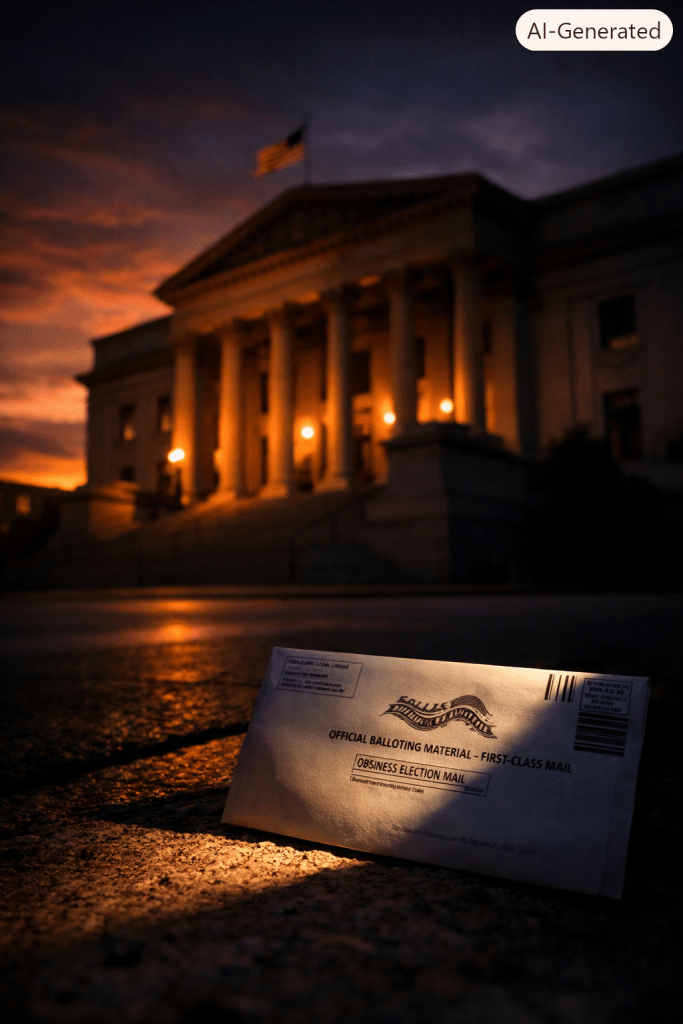
BREAKING: Courts Strike Down Trump’s Election Order Amid Growing Contradiction Over Mail‑In Voting
Washington, D.C. — July 27, 2026 In a dramatic legal escalation just months before the midterm elections, federal courts have blocked major portions of President Donald Trump’s executive order targeting mail‑in ballots and voter‑information systems — igniting a constitutional clash now barreling toward the Supreme Court. The rulings freeze the administration’s attempt to impose sweeping federal ballot‑handling rules, expanded voter‑verification procedures, and mandatory data‑reporting requirements on states and the U.S. Postal Service. Judges said the order violated constitutional limits on executive power and threatened to destabilize election systems already in motion. It’s understandable to feel the weight of these developments — election rules affect everyone, and sudden changes can create real uncertainty, especially when they touch something as personal and fundamental as the right to vote.
Courts emphasized that the President cannot override state election laws through executive action, citing the Elections Clause and the Tenth Amendment. Judges also warned that implementing new rules this close to Election Day would cause voter confusion, administrative chaos, and irreparable harm. Their decisions rely heavily on the Supreme Court’s Purcell Principle, a doctrine discouraging courts from changing election rules in the final months before voting begins. These rulings reflect a judicial effort to maintain stability during a sensitive moment in the election cycle, and it’s natural to feel uneasy when that stability is threatened.
The U.S. Postal Service — which had already begun preliminary steps to comply with the order — was forced to halt implementation immediately. The blocked provisions included new ballot‑tracking rules, enhanced chain‑of‑custody procedures, and expanded reporting of voter‑specific data to federal agencies. USPS officials say they are reverting to standard election protocols as states finalize ballots and prepare for early voting. For many people, the Postal Service is not just a government agency — it’s the lifeline that allows them to participate in democracy. When its role is disrupted, the fear of being shut out of the process becomes very real.
Public records show that Donald Trump has cast mail‑in ballots multiple times in Florida elections, including during his presidency. He used absentee voting repeatedly, at times praising its convenience and reliability. This creates a clear irony: the President has personally relied on the very system his administration is now attempting to restrict. Moments like this can feel disorienting — when leaders act in ways that contradict their own behavior, it becomes harder for people to trust the system they depend on.
Legal analysts say the contradiction at the heart of the executive order is even more glaring than the irony. For years, Trump has publicly claimed that mail‑in voting is insecure, vulnerable to fraud, and damaging to election integrity. Yet his own voting record shows he has repeatedly used — and trusted — the same mail‑in system he now seeks to limit for millions of Americans. This is not a minor inconsistency. It is a direct collision between Trump’s personal behavior and his public claims and policy actions. Experts say this contradiction raises serious questions about the underlying motivations of the executive order. It’s understandable if this feels frustrating or confusing — contradictions in policy can make it harder for people to feel confident in the system, especially when the stakes are this high.
“This is a textbook contradiction,” said Dr. Elaine Mercer, a constitutional law professor. “The President’s personal actions demonstrate confidence in mail‑in voting, while his policy position attempts to undermine it. Those two realities simply cannot coexist.” Another analyst was even more blunt: “If mail‑in voting is unsafe, why did he use it?” asked Michael Reddington, an election‑law researcher. “If it’s safe enough for him, why isn’t it safe enough for everyone else?” These reactions reflect how deeply experts are grappling with the implications — and it’s okay if readers are processing them too.
Legal analysts say the dispute is almost certain to reach the Supreme Court — but the timing may be decisive. With military and overseas ballots already being prepared and state deadlines rapidly approaching, the justices have historically refused to intervene in late‑cycle election changes. “The Court has been extremely consistent,” one election‑law expert said. “When executive orders collide with state election authority, especially this close to an election, the states almost always win.” In moments like this, many people look to the courts for clarity, and it’s understandable to hope for a steady resolution.
The blocked provisions include new federal ballot‑rejection criteria, expanded voter‑information collection, mandatory state reporting requirements, and changes to USPS ballot‑handling procedures. If the Supreme Court declines to intervene, those sections will remain frozen through the midterms. For now, the rulings mark one of the most significant legal setbacks for the administration’s election‑related directives — and highlight a growing national debate over the limits of presidential power, the role of states, and the future of mail‑in voting in America.
This is where the danger becomes impossible to ignore — and where emotional clarity matters most. If Trump ultimately succeeds in enforcing this executive order, the consequences could ripple far beyond administrative inconvenience. Millions of voters who rely on mail‑in ballots — seniors, disabled Americans, deployed service members, people working multiple jobs, rural communities without nearby polling places — could suddenly find themselves facing new barriers that make voting harder or even impossible. The danger is not theoretical. It is deeply human.
A rushed federal overhaul of state election systems could create widespread confusion, miscommunication, and inconsistent ballot handling. People who have voted the same way for years could be told their ballots no longer meet new federal criteria. USPS workers could be forced to follow unfamiliar procedures under intense political pressure. Local election offices — already stretched thin — could be overwhelmed by new reporting mandates they were never designed to handle. In the worst‑case scenario, ballots could be delayed, rejected, or lost in the chaos.
The emotional impact of that possibility is real. When people fear their vote might not count, they fear losing their voice. They fear losing their place in the democratic process. And that fear — that sense of being pushed out of something so fundamental — is a danger in itself. It erodes trust, weakens participation, and leaves people feeling powerless. It’s completely valid to feel concerned, even alarmed, about what this would mean for the stability and fairness of the election process. Protecting access to voting is not just a legal issue — it’s a human one.
References (Clickable Blue Links)
Elections Clause (Article I, Section 4) constitution.congress.gov/browse/article-1/section-4 (constitution.congress.gov in Bing)
Tenth Amendment constitution.congress.gov/browse/amendment-10 (constitution.congress.gov in Bing)
Purcell v. Gonzalez (2006) supreme.justia.com/cases/federal/us/549/1 (supreme.justia.com in Bing)
Florida Department of State — Voter History Search dos.myflorida.com/elections
U.S. Courts — Opinions & Records uscourts.gov/court-records (uscourts.gov in Bing)
Election Law Journal liebertpub.com/loi/elj
Brennan Center for Justice — Voting Analysis brennancenter.org/issues/voting

